The SuitThe Suit
TeardownPartsEngineeringClassroomField NotesThe ProjectGet Started

Parts

Iron Man suit parts: every piece, from helmet to boots

Short answer

This teardown splits the Iron Man suit into 81 named parts across 8 systems: 12 in the helmet and head, 8 in the chest and arc reactor, 12 in the back and flight pack, 18 under the armor, 4 in the abdomen and pelvis, 16 in the arms and gauntlets and 11 in the legs and boots. The films never give an official count; these are the pieces a working suit would need, each mapped to the real material or technology closest to it.

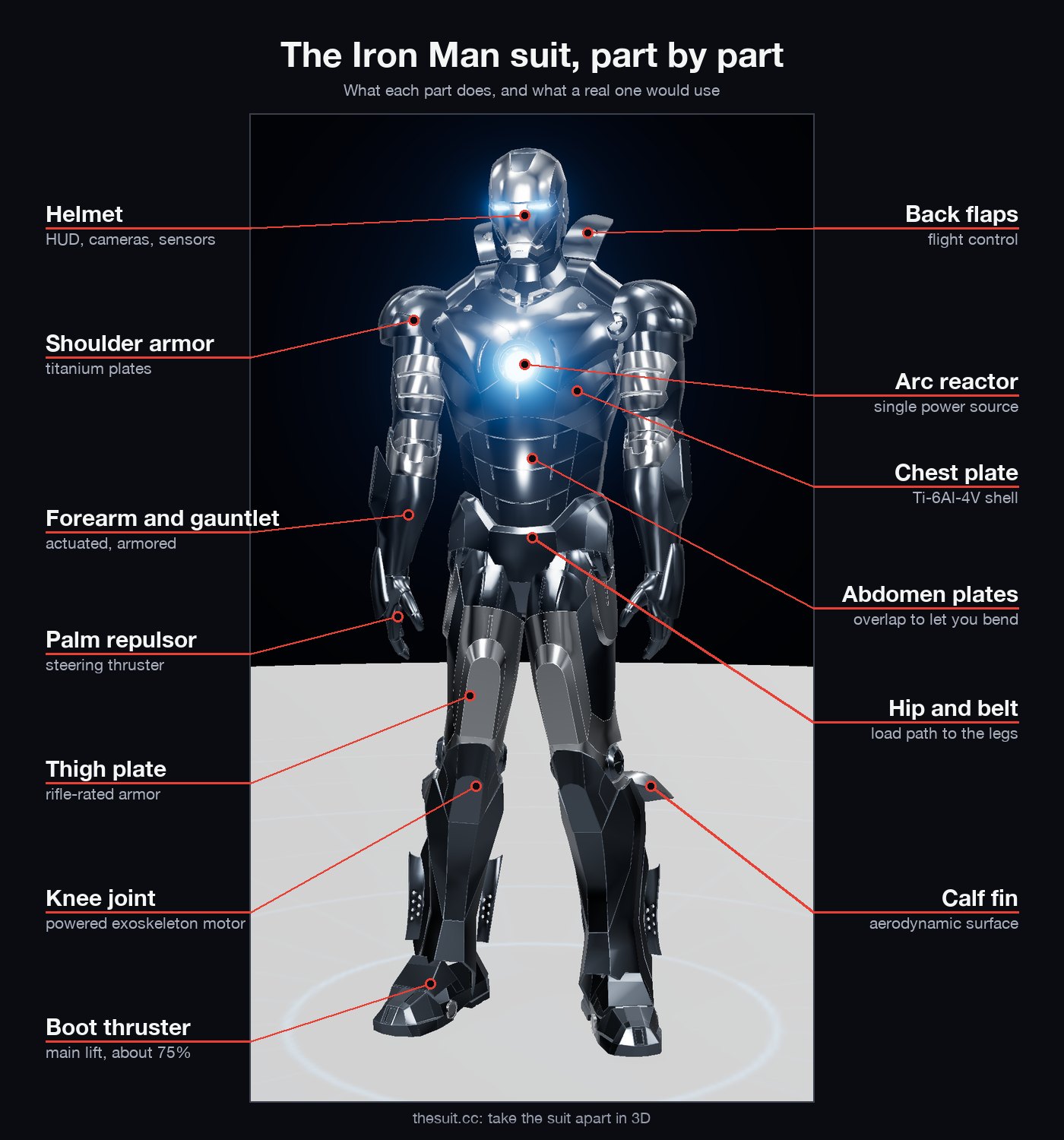
Labeled diagram of the Iron Man suit's parts: helmet, shoulder armor, forearm and gauntlet, palm repulsor, thigh plate, knee joint, boot thruster, back flaps, arc reactor, chest plate, abdomen plates, hip and belt, calf fin
The suit's main parts labeled, from the helmet to the boot thrusters. Every one is listed below with its material and what it does. Explore it in 3D

The suit is built in layers: a sealed sensor undersuit against the skin, a load-bearing endoskeleton, an artificial-muscle layer, impact padding and an outer shell of titanium plates. Below, every part is listed where it sits on the body, with what it would be made of, what it does, how it moves and the real physics behind it. To see them in place, open the interactive 3D teardown and click any plate, or go straight to the exploded view; for whether each system could really work, read the engineering verdict.

On this page

  1. Helmet and head 12
  2. Chest and arc reactor 8
  3. Back and flight pack 12
  4. Under the armor 18
  5. Abdomen and pelvis 4
  6. Arms and gauntlets 16
  7. Legs and boots 11
  8. Questions

Helmet and head (12 parts)

The helmet is the most crowded volume of the suit: a titanium shell and a hinged faceplate around the HUD visor, the cameras, the gaze tracker, the microphones and the oxygen regulator, sealed to the body at the gorget.

See the head & helmet in 3D

Cranial Shell / Skull Cap

Armor & Protective Layers

Primary ballistic protection for the crown and rear of the head; the fixed dome the faceplate hinges from.

Made of
Ti-6Al-4V shell (~2-3mm) with gold-nitride (TiN) coating; carbon-fiber forehead insert
How it moves
Rigid one-piece shell; forms the structural anchor for the faceplate hinge at the rear crown. No articulation.
The physics
Ti-6Al-4V gives half the density of steel at ~880 MPa yield (more when heat-treated); a gold-nitride coating reproduces the fictional gold-titanium look while the real hardness is titanium's.

Retractable Faceplate

Armor & Protective Layers

Retractable front facial armor with eye and mouth slits; lifts to expose the wearer's face.

Made of
Gold-titanium alloy plate (~2-3mm), gold-hued front
How it moves
Rotates up on a rear hinge, 1 rotational DOF driven by a chin-mounted micro-servo; magnetic + mechanical over-center latch seals it shut against the jaw.
The physics
A thin curved plate on a single hinge; cosplay builds prove the exact chin-servo-plus-Bowden mechanism is buildable at this scale.

Jaw / Chin Guard

Armor & Protective Layers

Protects the mandible and lower face; the mating surface the faceplate seals against.

Made of
Gold-titanium alloy outer with a mesh lower-lip vent guard
How it moves
Fixed to the helmet shell; the mesh section vents exhaled air and mic pickup. No articulation.
The physics
Separate upper-lip and mesh lower-lip guards let the mouth slit pass breathing airflow without opening a ballistic gap.

Faceplate Lift Actuator + Linkage

Endoskeleton & Actuation

Raises and lowers the faceplate on command.

Made of
Brushless micro-servo + steel Bowden cable / spring-steel hinge wire
How it moves
Chin-mounted servo pulls a Bowden cord through top slots to rotate the plate; 1 DOF, spring-return biased.
The physics
Low-torque rotary actuation of a light plate; the real cosplay analogue confirms the movie mechanism is physically trivial.

Bi-ocular AR Waveguide Visor (HUD)

Avionics, Sensing & Compute

Projects the full heads-up display (targeting reticle, telemetry, sensor overlays) onto a see-through combiner focused at optical infinity.

Made of
Polycarbonate ballistic visor with an embedded diffractive/holographic waveguide combiner; OLED/LCoS microdisplays as image source
How it moves
Fixed inside the faceplate; microdisplays in the brow shell inject the image into the waveguide arms over both eyes.
The physics
F-35 Gen III HMDS analogue: 30x40 degree field of view, 100% binocular overlap, image at infinity; Motion-to-photon latency must stay near ~20 ms (people notice the difference between 14 and 23 ms) or world-locked symbology smears and nauseates.

Eye Lenses + Repulsor Cameras

Avionics, Sensing & Compute

External vision; the cameras act as eyeballs feeding a 360-degree panoramic view to the HUD, and provide the signature glowing eyes.

Made of
LED-backlit polycarbonate lens over CMOS camera sensors; EL-wire glow feed
How it moves
Fixed in the two eye apertures; feeds stitched into the HUD compositor.
The physics
Camera-through-armor removes reliance on the physical eye slit; a dedicated video processor stitches feeds in real time before display.

Head + Gaze Tracker

Avionics, Sensing & Compute

Slaves the targeting reticle to where the operator looks (look-to-lock) and stabilizes world-fixed symbology as the head moves.

Made of
Hybrid magnetic head-tracker coil fused with an infrared eye-tracking camera pair
How it moves
Magnetic reference on the neck ring; IR emitters/cameras around the eye box; software fusion in the flight computer.
The physics
F-35 pilots cue weapons by looking; tracker-to-photon latency under ~20 ms is mandatory to keep world-locked symbols from smearing.

Voice / Natural-Language Mic Array

Avionics, Sensing & Compute

Hands-free conversational command channel to the suit AI while the hands are occupied.

Made of
Beamforming MEMS microphone array with active noise cancellation
How it moves
Embedded in the chin bar around the mouth; beamforming isolates the wearer's voice.
The physics
Beamforming rejects wind and repulsor noise; voice is the primary interface because gesture input is unavailable mid-maneuver.

Neural / EEG Interface Electrodes

Avionics, Sensing & Compute

Read brainwave / intent signals to help drive the display and armor control.

Made of
Dry-contact silver-chloride electrode pads
How it moves
Forehead and temple interior contacts against the scalp; feed the compute node.
The physics
Complements the implanted forearm micro-repeaters; real dry-EEG is far lower-bandwidth than the lore implies but the sensing modality is genuine.

Oxygen Intake / Demand Regulator

Life Support & Seals

Supplies breathable gas and positive-pressure anti-G breathing at the helmet.

Made of
Compressed-O2 micro-tank feed + mechanical demand regulator
How it moves
Regulator in the chin cavity feeding the sealed helmet volume from the dorsal supply.
The physics
A rigid articulated shell can hold near sea-level pressure, unlike a fabric spacesuit that must drop to 4.3 psi pure O2 to stay flexible.

Gorget / Neck Seal

Armor & Protective Layers

Protects the neck, seals the helmet to the torso, and permits head rotation.

Made of
Overlapping gold-titanium lames over a flexible aramid seal ring
How it moves
Articulated overlapping ring, allowing head yaw/pitch while maintaining a pressure seal; the mechanical bridge between helmet and chest collar.
The physics
The pressure-sealing element that lets the shell function as a self-contained environment in vacuum, altitude, or underwater.

Pressure Regulator + Neck Ventilation Loop

Life Support & Seals

Holds survivable internal pressure and circulates conditioned gas across the visor to clear CO2 and prevent fogging.

Made of
Mechanical demand regulator, elastomeric neck-ring seal, small brushless circulation fan
How it moves
Fan blows gas across the visor first (defog), then to the mouth, then back to the scrubber.
The physics
CO2 washout at the helmet inlet, not raw scrubber capacity, sets the required ventilation flow under peak exertion.

Chest and arc reactor (8 parts)

The chest carries the power source and the heaviest protection: the arc reactor in its housing, the unibeam projector, pectoral plates over a ceramic strike plate, a radar panel and a phase-change heat sink.

See the chest & arc reactor in 3D

Arc Reactor Core

Arc Reactor & Power Bus

Primary power plant for the entire suit, every actuator, and every weapon.

Made of
Fictional miniaturized fusion/plasma torus (palladium, later a synthesized element); ~5cm chest puck
How it moves
Locks into the chest socket; the single power source, also doubling as the wearer's cardiac shrapnel-restraint magnet in lore.
The physics
Canonical output ~3 GW (3 gigajoules/second), ~4 million hp, orders of magnitude beyond any real 5cm source; it is the enabling fiction every other subsystem is sized against.

Reactor Chest Housing (RT Socket)

Arc Reactor & Power Bus

Mounts and locks the reactor, transfers power out, and frames the unibeam emitter.

Made of
Titanium housing with a superconducting bus interface; tungsten/tantalum inner liner
How it moves
Rigid socket in the sternum framed by the pectoral plates; mechanical mount for the unibeam lens.
The physics
The one component with no bulk real analogue; the nearest plasma-facing materials are refractory tungsten (melting point 3422 C) and tantalum.

Superconducting Confinement Coil

Arc Reactor & Power Bus

Sustains and confines the fusion plasma torus inside the reactor.

Made of
Nb3Sn / REBCO high-temperature superconducting tape in a toroidal winding
How it moves
Static toroidal coil around the core; the real-world analogue to the glowing on-screen ring.
The physics
The toroidal-coil geometry matches real fusion confinement; superconductors are how you carry gigawatt-class current without ohmic loss.

Unibeam Chest Projector

Repulsors & Directed Energy

High-power forward directed-energy beam drawn straight from the reactor; also EMP, scanner, and holo-projector.

Made of
Large-aperture lensed emitter over the reactor; refractory tungsten aperture
How it moves
Fixed coaxial with the reactor, firing forward; recoil must be countered by boots/RCS if fired in hover.
The physics
Ceiling is the reactor's ~3 GW; as a beam that is enormous, but its photon recoil is only ~10 N even at the full 3 GW (force = power / c), so it contributes nothing to lift; at a realistic ~40% laser efficiency, ~1.8 GW would stay in the chest as heat.

Pectoral Plates

Armor & Protective Layers

Protect the heart and lungs and frame the reactor; the principal frontal armor and most iconic silhouette panel.

Made of
Gold-titanium alloy over a Sorbothane backing
How it moves
Two mirrored halves latched to the endoskeleton; separate at the seam during the exploded view.
The physics
Titanium exterior carries impact while the viscoelastic backing spreads blunt force off the wearer.

Chest Ceramic Strike Plate

Armor & Protective Layers

Hard ceramic ballistic strike face over the reactor and vital organs that shatters and blunts incoming projectiles.

Made of
Boron carbide (B4C) + graphene, spark-plasma sintered, over an aramid/CNT backer
How it moves
Bonded ceramic tile laminated to the plate behind the pectoral armor; brittle, so paired with a ductile catcher.
The physics
B4C is one of the hardest ceramics (~31 GPa Vickers at low load) at only 2.52 g/cm3 (1/3 of steel), but brittle under repeated hits. Multi-hit zones use SiC instead.

AESA Millimeter-Wave Radar Panel

Avionics, Sensing & Compute

Active radar for through-obscurant detection, ranging, and weapon cueing independent of the IR array.

Made of
Gallium-nitride T/R module active electronically scanned array, conformal patch
How it moves
Flat conformal aperture in the chest plastron; electronically steered, no moving gimbal.
The physics
Electronic beam steering suits an armor plate; conformal packaging trades aperture size (range/resolution) for a body-mountable footprint.

Phase-Change Heat-Sink Jacket

Thermal Management

Absorbs peak thermal transients (weapon discharge, reactor surges) by melting, buffering heat the radiators cannot shed instantly.

Made of
Encapsulated paraffin or salt-hydrate phase-change-material slabs
How it moves
Sandwiched around the reactor housing; re-solidifies as the radiators catch up.
The physics
Decouples instantaneous heat generation from steady-state rejection at constant temperature; standard spacecraft technique for fluctuating loads.

Back and flight pack (12 parts)

The back is where everything that needs volume lives: the flight computer, radios and antennas, oxygen generation and CO2 scrubbing, the coolant pump and the radiator panels that reject heat, under a spine plate with stabilizer flaps.

See the back & thrusters in 3D

Spine / Back Plate

Armor & Protective Layers

Posterior torso protection that mounts the flight flaps and doubles as a heat-sink surface.

Made of
Gold-titanium alloy with a finned inner face
How it moves
Rigid dorsal panel latched to the endoskeleton spine; the largest flat external area.
The physics
The back is the primary thermal hub because it offers the most flat exterior area for radiative and convective rejection.

Back Flight Flaps / Stabilizer Fins

Flight & Propulsion

Deploy in flight for aerodynamic pitch/yaw stability and airbraking; offload the RCS at speed.

Made of
Gold-titanium alloy or composite panels on actuated hinges
How it moves
Retractable hinged flaps, 1 DOF each, driven by servos; stow flush at hover.
The physics
Effective only above ~50-100 m/s where dynamic pressure is usable; rapid deployment for evasion is exactly what generates lethal g-loads on the wearer.

Variable-Emissivity Radiator Panels

Thermal Management

Dumps collected waste heat to the environment as radiation and convection.

Made of
High-emissivity back plates with an electrochromic variable-emissivity coating
How it moves
External back and shoulder panels; emissivity throttled electrically to modulate rejection.
The physics
A radiator sheds only ~350 W/m2 at 300 K, so ~2.9 m2 is needed per kW; a body offers under ~2 m2, making steady kilowatt rejection the single hardest real problem, especially in vacuum where convection is gone.

Peltier Thermoelectric Cooling Array

Thermal Management

Actively pumps heat from the interior to the back-plate radiators to hold the interior near 25 C.

Made of
Bismuth-telluride Peltier modules on a finned heat sink
How it moves
Solid-state modules bonded to the back plates; no moving parts, current-driven.
The physics
Peltier cooling with the back plates as heat sinks targets a ~25 C interior; the shell is not hermetically sealed, so active ventilation is also required.

Sensor-Fusion Flight Computer

Avionics, Sensing & Compute

The central compute node: fuses IR sphere, radar, LIDAR, IMU, and GNSS into one world model, drives the HUD, runs the assistant, and closes the flight and EMG loops.

Made of
Ruggedized SoC with a dedicated edge-AI/NPU accelerator, redundant cores, conduction-cooled
How it moves
Mounted in the dorsal pack, the coolest large-volume location next to the radiators.
The physics
Runs Kalman/particle-filter fusion and CNN/LSTM inference; it is the largest continuous heat source after the reactor, which is why the back is the thermal hub. The AI is effectively the pilot, the human the manager.

Software-Defined Radio

Avionics, Sensing & Compute

Reconfigurable multi-band transceiver for voice, tactical data link, telemetry, and mesh networking.

Made of
Wideband SDR transceiver with a GaN power amplifier
How it moves
Dorsal-pack module feeding conformal antennas; waveforms swapped in software.
The physics
One box covers Link 16 (960-1215 MHz, jam-resistant, frequency-hopped), MANET mesh, and SATCOM; reconfigurability is what lets it talk to jets, ground units, and satellites.

Conformal Multi-Band Antennas

Avionics, Sensing & Compute

Radiates and receives across the SDR's bands without a protruding whip.

Made of
Flush-laminated conformal dual-band antenna, UHF 225-450 MHz and L-band 1.3-2.6 GHz
How it moves
Laminated flush into the shoulder pauldrons and upper back, sky-facing for coverage.
The physics
Body blockage is the key constraint, so spatially diverse elements give all-aspect coverage while staying aerodynamically flush.

Distributed-Aperture IR Camera Array

Avionics, Sensing & Compute

Stitches a seamless spherical infrared picture so the operator can look through the armor in any direction, with automatic threat detection and night vision.

Made of
6+ mid-wave infrared (HgCdTe/InSb) focal-plane arrays behind sapphire windows
How it moves
Six-plus staring sensors distributed over crown, shoulders, chest, and back with overlapping coverage; no aiming input.
The physics
AN/AAQ-37 analogue: 6 MWIR cameras form a full 4-pi-steradian sphere and tracked a two-stage rocket launch at more than 800 miles (about 1,290 km) in a 2010 flight test, flown on a test aircraft.

OBOGS Oxygen Generation Unit

Life Support & Seals

Provides breathable gas at altitude, in vacuum, or in contaminated air, plus anti-G positive-pressure breathing.

Made of
Molecular-sieve OBOGS (~95% O2 / ~5% argon) with a high-pressure O2/LOX reserve bottle
How it moves
Dorsal-pack unit feeding the neck ring; sieve beds cycle to produce oxygen from feed air.
The physics
OBOGS gives near-unlimited endurance wherever feed air exists; the reserve bottle covers the sealed/vacuum case.

CO2 Scrubber

Life Support & Seals

Removes exhaled CO2 from the recirculated breathing loop to prevent hypercapnia in the sealed helmet.

Made of
Regenerable amine or metal-oxide bed with a lithium-hydroxide canister fallback
How it moves
In the breathing return line in the dorsal pack; regenerable for reuse.
The physics
Spacesuit-PLSS pattern; CO2 washout rate at the helmet inlet is the sizing driver, not bed capacity alone.

Coolant Pump + Reservoir

Thermal Management

Drives coolant through the body cooling garment and the electronics cold plates and buffers transients.

Made of
Brushless magnetically coupled pump with an accumulator reservoir
How it moves
Two separate fluid paths (crew loop and equipment loop) share the reservoir but never mix.
The physics
Separating the loops means a hot compute spike can never heat the skin garment; the human's heat path stays independent of the electronics.

GNSS Receiver + Anti-Jam Antenna

Avionics, Sensing & Compute

Absolute position/velocity/time fix that bounds IMU drift and time-syncs sensor fusion.

Made of
Multi-constellation GNSS receiver with an anti-jam patch antenna
How it moves
Upper-back sky-facing antenna, tightly coupled to the IMU in the filter.
The physics
Low-cost MEMS gyros drift within minutes unaided, so tightly coupled GNSS aiding is mandatory, not optional, in GPS-contested conditions.

Under the armor (18 parts)

Beneath the plates the suit is a machine wrapped around a person: an endoskeleton and joint actuators that carry the load, an artificial-muscle layer, impact padding, a liquid cooling garment and a sensor bodyglove against the skin, with the power bus and wiring running through all of it.

Power Distribution Bus / Conduits

Arc Reactor & Power Bus

Routes reactor power to helmet, repulsors, actuators, and thermal systems.

Made of
Superconducting / copper-clad high-current cabling with insulation
How it moves
Trunked through the torso and out to each limb from the reactor socket.
The physics
Must carry gigawatt-class transients to the repulsor capacitor banks; superconducting sections avoid catastrophic ohmic heating at those currents.

Wiring & Fiber Harness

Avionics, Sensing & Compute

Distributes power and data to every sensor, actuator, and emitter node.

Made of
Shielded copper power lines + fiber-optic data bundles
How it moves
Trunked through the exoframe to all extremities with separated power/data shielding.
The physics
Must survive flight vibration and gigawatt transients; fiber isolates data from the electromagnetic noise of the power bus.

MEMS Inertial Measurement Unit (IMU/AHRS)

Avionics, Sensing & Compute

Measures body attitude, angular rate, and acceleration for the artificial horizon, flight stabilization, and dead-reckoning.

Made of
Tactical-grade MEMS tri-axis gyroscope + accelerometer + magnetometer
How it moves
Mounted rigidly near the center of mass beside the reactor.
The physics
Fused in an Extended Kalman Filter with GNSS; without aiding, MEMS heading drifts within minutes, so continuous bias correction is required for stable hover.

Endoskeleton / Exoframe

Endoskeleton & Actuation

Load-bearing internal skeleton that every plate and actuator mounts to; transfers structural, thrust, and landing loads.

Made of
Ti-6Al-4V primary space-frame with titanium-aluminide stiffness struts and maraging-steel joint inserts
How it moves
Full-body frame beneath the plating; separates structure from skin so the outer ceramic/gold plating never carries primary load.
The physics
Titanium's strength-to-weight (4.43 g/cm3, ~880 MPa yield annealed) beats steel for the bulk frame; maraging steel (~2000 MPa yield) is used only at peak-load joints because it is heavy at ~8.0 g/cm3.

Artificial-Muscle (Myomer) Layer

Endoskeleton & Actuation

Amplifies wearer strength; contractile actuators that move the limbs with the endoskeleton.

Made of
Dielectric electroactive polymer (EAP) or McKibben pneumatic artificial muscle
How it moves
Wrapped over the exoframe across the whole body; contracts on command in parallel with the servos.
The physics
Real research pursues pneumatic/EAP artificial muscles for exactly this strength-multiplication role; it is the compliant layer under the rigid plates.

Nitinol Shape-Memory Actuator Bundles

Endoskeleton & Actuation

Silent, motorless powered actuation and flexible connective tissue spanning every joint.

Made of
Near-equiatomic nickel-titanium (NiTi) shape-memory alloy wire
How it moves
Electrically actuated NiTi wire contracts via a martensite-austenite transformation; no motors, 2-6% strain for long life.
The physics
Manufacturer-rated ~172 MPa working stress at 2-6% strain for long life; transformation temperature is tunable. Downside is slow thermal cycling, since every contraction waits on the wire heating and cooling.

Joint Servo Actuators

Endoskeleton & Actuation

Drive each powered joint (shoulder, elbow, wrist, hip, knee, ankle) for strength multiplication.

Made of
Brushless DC servos with harmonic-drive reduction
How it moves
One actuator per major joint, high reduction ratio; sized for gigawatt-fed torque.
The physics
Harmonic drives give high torque density and near-zero backlash, the real basis of powered-exoskeleton strength assist.

Hydraulic Shock Absorbers

Endoskeleton & Actuation

Power assist and impact absorption at high-load points during landing and heavy actuation.

Made of
Sealed hydraulic cylinders with fluid lines
How it moves
Mounted at the main spine, lumbar, and armpits per teardown analyses; damp and store landing energy.
The physics
A ~104 m/s descent of ~250 kg of suit and wearer carries ~1.4x10^6 J to absorb, so these are load-bearing design elements, not flavor.

Impact / Shear-Thickening Damping Layer

Armor & Protective Layers

Soft and flexible in motion but instantly rigid on impact, converting blunt force to heat and spreading it off the wearer.

Made of
Sorbothane viscoelastic polymer combined with shear-thickening fluid (D3O/STF) padding
How it moves
Sits between the outer shell and the undersuit over the whole body; non-Newtonian stiffening is reversible.
The physics
STF viscosity spikes above a critical shear rate, so the padding is soft in motion and stiff on impact, easing the no-room-for-padding problem of a tight suit.

Auxetic Lattice Joint Gussets

Endoskeleton & Actuation

Flexible connective tissue between rigid plates that flexes with the body yet densifies at an impact point.

Made of
Additively manufactured auxetic (negative-Poisson-ratio) re-entrant lattice
How it moves
Placed at joint gussets, plate-to-plate gaps, and underarm/groin flex zones; material flows toward a strike.
The physics
Negative Poisson's ratio densifies under compression; ballistic FEA shows auxetic-core sandwich armor absorbs far more energy than monolithic panels.

Undersuit / Sensor Bodyglove

Life Support & Seals

Sealed base layer, sensor substrate, and the interface between wearer and machine.

Made of
Nomex/aramid knit with a woven conductive sensor mesh
How it moves
Innermost full-body layer hosting the neural/EMG contacts and routing wiring.
The physics
Carries the EMG and biometric contacts against the skin and manages moisture; the human-machine boundary layer.

Liquid Cooling & Ventilation Garment

Thermal Management

Removes metabolic body heat by circulating chilled water through fine tubing in direct skin contact.

Made of
Spandex/nylon body stocking with a network of thin-wall EVA/PVC tubing
How it moves
Full-body base layer; about 91.5 m of fine tubing (the NASA EMU figure); the human's primary heat path.
The physics
NASA designed the EMU cooling garment for ~290 W average and ~580 W peak body heat; the electronics use a separate loop so their heat never reaches the skin.

Heat-Pipe / Pumped-Loop Network

Thermal Management

Transports heat from concentrated hot spots (reactor, compute, repulsor drivers) to the radiator plates and PCM.

Made of
Copper/ammonia heat pipes plus a mechanically pumped single-phase fluid loop
How it moves
Routed through the armor between hot sources and the back radiators; heat pipes are passive, the pump handles high flux.
The physics
Same two-tier transport spacecraft use between components and the ultimate heat sink; heat pipes move heat with no moving parts.

Environmental Pressure Seals

Life Support & Seals

Maintain the self-contained internal environment for vacuum, high altitude, and underwater.

Made of
Elastomer gaskets at every plate seam and the gorget
How it moves
Compression gaskets at all articulation seams and the neck ring.
The physics
Provide the sealed environment the life-support system pressurizes; every articulating seam is a potential leak path that must gasket.

Plate Latches / Locking Mechanisms

Endoskeleton & Actuation

Lock adjacent plates into their assembled rigid position and release them for donning or self-assembly.

Made of
Electromagnetic + mechanical over-center latches
How it moves
One at every plate-to-plate seam; over-center mechanical lock backed by electromagnets.
The physics
The mechanism that turns loose lames into a rigid load-carrying shell and reverses it for the exploded/assembly sequence.

Reaction-Control Attitude Thruster Cluster

Flight & Propulsion

Fire in opposed pairs to produce pure torque for roll/pitch/yaw trim and millisecond disturbance rejection.

Made of
Cold-gas or bleed-air micro-nozzles with solenoid pulse valves on a titanium manifold
How it moves
Distributed at hips, shoulder blades, back, and outer limbs for maximum moment arm; phase-plane pulse logic nulls angular-rate error.
The physics
On a human-scale body only tens of newtons at a ~0.3-0.5 m moment arm counter tumble, but they must react in milliseconds; this layer keeps the four main emitters from spinning the pilot.

Surface EMG Electrode Array

Endoskeleton & Actuation

Reads muscle activation to detect movement intent and drive the actuators in sync with the wearer instead of resisting.

Made of
Dry surface EMG electrodes woven into the undersuit over the major muscle groups, decoded by a CNN/LSTM myoelectric model
How it moves
Electrodes over biceps, forearms, deltoids, quads, and calves feed the compute node; loop closed with IMU and haptics.
The physics
Surface EMG registers the muscle's electrical command before the resulting force builds (the electromechanical delay, tens of milliseconds), the lead time an actuator needs to assist; the decoder loop must beat that window and reject motion artifact, crosstalk, and 50/60 Hz interference.

Modular Piece-Propulsion Pods + Magnetic Couplers

Flight & Propulsion

Give each armor section its own thrusters so it can fly to the wearer and self-assemble in mid-air.

Made of
Miniature repulsor/thruster with per-module guidance and electromagnet mating pairs
How it moves
One pod per detachable module; magnetic couplers seek and snap flying pieces into registration before the mechanical latches lock.
The physics
Basis of the autonomous prehensile-propulsion suit, coordinated by ~48 implanted micro-repeater chips; each piece balances, avoids obstacles, and attaches while airborne.

Abdomen and pelvis (4 parts)

Segmented lames let the torso bend while a spine actuator column carries load through it. The emergency backup battery sits here, and the pelvic plates tie the torso armor to the legs.

See the abdomen in 3D

Abdominal Segmented Lames

Armor & Protective Layers

Flexible torso armor that lets the wearer bend and twist.

Made of
Overlapping gold-titanium lames on an elastic backing
How it moves
Overlapping segments slide over one another (the overlap is the flex mechanism); split into front-abs and side-abs pieces.
The physics
Segmentation trades a monolithic plate's rigidity for range of motion while still shielding the midriff.

Spine Actuator Column

Endoskeleton & Actuation

Articulates the torso and couples upper-body loads to the pelvis.

Made of
Linked vertebral actuators over the exoframe spine
How it moves
Series of linked actuators along the spine, allowing controlled bend and twist under load.
The physics
Lets the armored torso flex while carrying flight and landing loads through to the pelvis and legs.

Emergency Backup Battery

Arc Reactor & Power Bus

Bridging power and cold-start reserve if the reactor is offline.

Made of
Lithium-sulphur cells (~500 Wh/kg)
How it moves
Housed in the lower-back/abdominal cavity, tied into the power bus.
The physics
The best real cells (silicon-anode lithium-ion) reach ~500 Wh/kg, and 10 kg of them hovers a person for under a minute, underscoring how far real storage is from the reactor.

Pelvic Girdle / Codpiece Plates

Armor & Protective Layers

Hip and groin protection while permitting the hip joint's full range.

Made of
Segmented gold-titanium alloy
How it moves
Segmented so the wearer can sit, crouch, and run; anchors the thigh armor to the torso.
The physics
The articulation-versus-coverage tradeoff at the hip is resolved by segmentation, as in historical plate armor.

Arms and gauntlets (16 parts)

The arms carry the hands-on hardware: shoulder pauldrons, arm plates and bracers, a wrist launcher, an EMG cuff that reads the wearer's gestures, and in each palm a repulsor fed by a capacitor bank.

See the left arm & gauntlet in 3D

Left Deltoid Pauldron

Armor & Protective Layers

Shoulder-cap protection that clears the arm's full range of motion and mounts a secondary emitter.

Made of
Gold-titanium alloy layered lames; houses a shoulder repulsor/aileron
How it moves
Overlapping lames slide to let the arm raise; the pauldron also carries a back/shoulder repulsor emitter.
The physics
Overlapping lames keep coverage across the deltoid's wide arc; the shoulder emitters act as secondary blasters and flight-attitude stabilizers.

Right Deltoid Pauldron

Armor & Protective Layers

Shoulder-cap protection that clears the arm's full range of motion and mounts a secondary emitter.

Made of
Gold-titanium alloy layered lames; houses a shoulder repulsor/aileron
How it moves
Mirror of the left pauldron; overlapping lames slide for arm elevation and carry a shoulder emitter.
The physics
Same overlapping-lame articulation and secondary-emitter role, mirrored to the right side.

Bicep Plate (mirrored L/R)

Armor & Protective Layers

Upper-arm anterior protection.

Made of
Gold-titanium alloy clamshell
How it moves
Rotates on the upper-arm frame with the shoulder; mirrored on both arms.
The physics
A clamshell that follows the humerus so the plate never binds during arm rotation.

Tricep Plate + Elbow Cop (mirrored L/R)

Armor & Protective Layers

Upper-arm posterior protection and a sliding shield over the elbow joint and its actuator.

Made of
Gold-titanium alloy with a poleyn-style elbow cap
How it moves
Mates to the bicep plate around the humerus; the poleyn cap slides over the elbow servo and must not bind at full flex. Mirrored both arms.
The physics
The telescoping cop keeps the joint and actuator covered through the full flexion arc without jamming.

Left Forearm Bracer

Armor & Protective Layers

Forearm protection and the housing for weapon flaps.

Made of
Gold-titanium alloy two-piece clamshell
How it moves
Clamshell opens to admit the hand and to deploy the missile flaps.
The physics
Two-piece construction lets a rigid tube open around the wrist while still armoring the forearm.

Right Forearm Bracer

Armor & Protective Layers

Forearm protection and the housing for the EMG gesture cuff.

Made of
Gold-titanium alloy two-piece clamshell
How it moves
Mirror of the left bracer; opens to admit the hand.
The physics
Same opening clamshell, mirrored, wrapping the forearm sensor band on the right side.

Wrist Micro-Missile Launcher

Repulsors & Directed Energy

Fires small guided micro-missiles and flare/chaff countermeasures.

Made of
Composite launch tubes + solid-propellant micro-rockets
How it moves
Deploys through hinged flaps in the dorsal forearm bracer.
The physics
Solid-propellant micro-rockets are the one weapon subsystem that is straightforward real ordnance, unlike the beam weapons.

High-Density EMG Gesture Cuff

Endoskeleton & Actuation

Fine decoding of hand and finger intent for repulsor aiming and discrete commands.

Made of
High-density surface EMG (HD-sEMG) electrode band
How it moves
Circumferential band on the forearm inside the bracer; pairs with eye-tracking for aim-by-gaze, confirm-by-gesture.
The physics
HD-sEMG resolves individual gestures well enough for reliable discrete control, the muscle-side counterpart to the neural interface.

Micro-Repeater Neural Implants

Avionics, Sensing & Compute

Brain-machine interface chips that let the wearer command the modular pieces and armor by intent.

Made of
Surgically implanted silicon microchips
How it moves
~48 chips implanted in the forearms, feeding the control loop for autonomous piece propulsion.
The physics
Cited as 48-49 micro-repeaters; maps onto real neuroprosthetic research, though at far lower bandwidth than the lore implies.

Gauntlet Dorsal Plate (mirrored L/R)

Armor & Protective Layers

Protects the back of the hand and knuckles and carries the knuckle repulsors.

Made of
Gold-titanium alloy
How it moves
Anchors the finger lames and the palm emitter; mirrored on both hands.
The physics
The dorsal plate is the rigid hub the articulated finger armor and the palm emitter both mount to.

Finger Phalanx Lames (mirrored L/R)

Armor & Protective Layers

Articulated finger armor that follows the knuckles.

Made of
Gold-titanium alloy segments over flexible joints
How it moves
~3 segments per finger (~12-15 lames per hand) hinged to track finger flexion; palm repulsor sits at their base.
The physics
Per-phalanx segmentation is the only way to armor a hand and keep dexterity, the same principle as gauntlet armor.

Thumb Segment Plates (mirrored L/R)

Armor & Protective Layers

Articulated thumb armor with independent opposable motion.

Made of
Gold-titanium alloy segments
How it moves
Two segments hinged separately from the fingers for opposition.
The physics
The thumb needs its own articulation axis to preserve grip, so it is armored as a separate two-segment chain.

Left Palm Repulsor Emitter

Repulsors & Directed Energy

Hand-aimed thrust for lift trim, roll authority, and braking, plus a weaponized directed-energy blast.

Made of
Tungsten/ceramic emitter ring + focusing lens; ducted-fan/jet thrust source for the lift function
How it moves
Center of the palm, thrust normal to the hand, aimed by wrist and shoulder; long moment arm gives attitude control the boots cannot.
The physics
Modeled at ~25% of hover thrust (~111 N on a 90 kg system). Critical conflict: real ion and plasma thrusters make fractions of a newton to ~5 N, and the ~5 N one (NASA's X3) is 80 cm across and weighs 230 kg, so the lift must actually be reaction mass (a jet) while the glowing beam is a separate weapon sharing the aperture.

Right Palm Repulsor Emitter

Repulsors & Directed Energy

Hand-aimed thrust for lift trim, roll authority, and braking, plus a weaponized blast.

Made of
Tungsten/ceramic emitter ring + focusing lens; ducted-fan/jet thrust source for the lift function
How it moves
Mirror of the left; together the two palms plus two boots form a naturally stable four-point thrust stance.
The physics
Same ~25% thrust share and same beam-versus-jet split, mirrored.

Repulsor Capacitor / Supercapacitor Bank

Arc Reactor & Power Bus

Stores and pulses the high-current charge each emitter needs to fire.

Made of
Supercapacitor / pulse-forming network
How it moves
Sits immediately behind each repulsor emitter, decoupling the millisecond weapon pulse from steady reactor output.
The physics
A directed-energy weapon draws its energy in milliseconds; the capacitor bank buffers the reactor so the bus is not hit with the full transient.

Fingertip Laser Cutter

Repulsors & Directed Energy

Short-range cutting/torch laser for breaching obstacles.

Made of
High-power laser diode + focusing optic
How it moves
Mounted at the gauntlet fingertip, aimed by the finger.
The physics
A focused diode torch is a genuinely buildable short-range cutter, in contrast to the impossible lift-capable repulsors.

Legs and boots (11 parts)

The legs carry the suit's weight to the ground and, in flight, most of its thrust: the two boot thrusters provide about three quarters of the lift, steered through an ankle gimbal.

See the left leg & boot in 3D

Left Thigh Armor (Cuisse)

Armor & Protective Layers

Upper-leg protection.

Made of
Gold-titanium alloy two-piece clamshell
How it moves
Two pieces around the femur that slide at the hip and knee interfaces.
The physics
Clamshell construction lets a rigid plate follow the femur through the hip and knee's range.

Right Thigh Armor (Cuisse)

Armor & Protective Layers

Upper-leg protection.

Made of
Gold-titanium alloy two-piece clamshell
How it moves
Mirror of the left cuisse; slides at the hip and knee.
The physics
Same clamshell articulation, mirrored to the right leg.

Knee Cop / Actuator Cover (mirrored L/R)

Armor & Protective Layers

Protects the knee joint and its actuator through full flexion.

Made of
Gold-titanium alloy poleyn
How it moves
Telescoping cover over the knee servo, matched to the elbow cop; mirrored both legs.
The physics
A telescoping poleyn keeps the joint covered across a wide flexion arc without jamming the actuator.

Left Shin Plate (Greave)

Armor & Protective Layers

Lower-leg frontal protection that houses landing shock structure.

Made of
Gold-titanium alloy clamshell over the landing-shock structure
How it moves
Clamshell from knee to ankle; opens for ankle articulation and absorbs landing loads into the frame.
The physics
Channels landing energy (~1.4x10^6 J for a ~104 m/s descent of ~250 kg) into the endoskeleton rather than the wearer's leg.

Right Shin Plate (Greave)

Armor & Protective Layers

Lower-leg frontal protection that houses landing shock structure.

Made of
Gold-titanium alloy clamshell over the landing-shock structure
How it moves
Mirror of the left greave; opens for ankle articulation.
The physics
Same landing-load path, mirrored to the right leg.

Calf Plate (mirrored L/R)

Armor & Protective Layers

Posterior lower-leg protection.

Made of
Gold-titanium alloy
How it moves
Mates to the greave and opens for ankle articulation; mirrored both legs.
The physics
Completes the lower-leg tube while leaving the ankle joint free to gimbal.

Ankle Gimbal Mechanism

Endoskeleton & Actuation

Multi-axis foot articulation for balance, landing, and thrust-vectoring the boot repulsor.

Made of
Gimbal bearing + servo
How it moves
Two-plus axis gimbal at the ankle keeping the boot thruster aimed and the wearer upright on uneven landings; mirrored both feet.
The physics
Thrust-vectoring the boot jet requires aiming the nozzle independently of leg pose, which the ankle gimbal provides.

Boot Dorsal Plate (mirrored L/R)

Armor & Protective Layers

Top-of-foot protection that frames the boot repulsor nozzle.

Made of
Gold-titanium alloy
How it moves
Instep plate over the foot; mirrored both feet.
The physics
Frames and shields the high-temperature thruster nozzle beneath the sole.

Articulated Toe Plates (mirrored L/R)

Armor & Protective Layers

Articulated forefoot armor for balance and walking.

Made of
Gold-titanium alloy segments
How it moves
Hinged so the foot can flex during walking and push-off; mirrored both feet.
The physics
Toe articulation preserves the natural foot roll needed to walk and balance in a rigid boot.

Left Boot Repulsor Thruster

Flight & Propulsion

Main flight propulsion, expelling thrust downward; carries the majority of lift.

Made of
Nickel-superalloy micro gas-turbine (real analogue) or high-Isp plasma nozzle; refractory/ablative throat liner with YSZ thermal-barrier coating
How it moves
Nozzle in the boot sole, thrust-vectored by the ankle gimbal; ~75% of total thrust split between the two boots.
The physics
Carries ~75% of hover thrust (~334 N per boot for a 90 kg system). The only demonstrated body-worn source is a gas-turbine jet suit (Gravity Industries: five micro-turbines, one on the back and two on each arm). Real turbine exhaust runs ~700 C exiting centimeters from the feet.

Right Boot Repulsor Thruster

Flight & Propulsion

Main flight propulsion, expelling thrust downward; carries the majority of lift.

Made of
Nickel-superalloy micro gas-turbine or high-Isp plasma nozzle; refractory/ablative throat liner with YSZ coating
How it moves
Mirror of the left; differentially vectored with the left boot for pitch and yaw.
The physics
Same thrust and thermal figures, mirrored; the two boots together set climb rate while differential vectoring gives attitude.

Questions about the suit's parts

How many parts does the Iron Man suit have?

This teardown splits the Iron Man suit into 81 named parts across 8 systems: 12 in the helmet and head, 8 in the chest and arc reactor, 12 in the back and flight pack, 18 under the armor, 4 in the abdomen and pelvis, 16 in the arms and gauntlets and 11 in the legs and boots. The films never give an official count; these are the pieces a working suit would need, each mapped to the real material or technology closest to it.

What parts make up the Iron Man helmet?

12 parts: Cranial Shell / Skull Cap, Retractable Faceplate, Jaw / Chin Guard, Faceplate Lift Actuator + Linkage, Bi-ocular AR Waveguide Visor (HUD), Eye Lenses + Repulsor Cameras, Head + Gaze Tracker, Voice / Natural-Language Mic Array, Neural / EEG Interface Electrodes, Oxygen Intake / Demand Regulator, Gorget / Neck Seal and Pressure Regulator + Neck Ventilation Loop. The shell would be titanium alloy (Ti-6Al-4V) about 2 to 3 mm thick, with the faceplate on a single rear hinge.

What is inside the Iron Man gauntlet?

The hand carries Gauntlet Dorsal Plate (mirrored L/R), Finger Phalanx Lames (mirrored L/R), Thumb Segment Plates (mirrored L/R), Left Palm Repulsor Emitter, Right Palm Repulsor Emitter, Repulsor Capacitor / Supercapacitor Bank and Fingertip Laser Cutter. The palm repulsor is the suit's steering thruster in flight, which is why it sits on a long arm away from the body.

Where is the arc reactor and what does it power?

In the center of the chest, locked into its housing. It is the suit's single power source, feeding every actuator, sensor, thruster and weapon through the power bus. Its system has 6 parts: Arc Reactor Core, Reactor Chest Housing (RT Socket), Superconducting Confinement Coil, Power Distribution Bus / Conduits, Emergency Backup Battery and Repulsor Capacitor / Supercapacitor Bank.

What do the Iron Man boots do?

They are the main flight engines: the two boot thrusters carry about 75% of the suit's lift, vectored by the ankle gimbal, while the palms do most of the steering. The boot has 5 parts: Ankle Gimbal Mechanism, Boot Dorsal Plate (mirrored L/R), Articulated Toe Plates (mirrored L/R), Left Boot Repulsor Thruster and Right Boot Repulsor Thruster.
The same parts, system by system

  • Arc Reactor & Power Bus6 parts
  • Armor & Protective Layers27 parts
  • Endoskeleton & Actuation12 parts
  • Flight & Propulsion5 parts
  • Repulsors & Directed Energy5 parts
  • Avionics, Sensing & Compute14 parts
  • Life Support & Seals6 parts
  • Thermal Management6 parts
The SuitThe Suit

An interactive engineering teardown of a Mark-class powered exosuit.

Product

  • Teardown
  • Parts
  • Engineering
  • Classroom
  • Field Notes
  • The Project

Legal

  • Privacy Policy
  • Terms of Service
  • Support
© 2026 The Suit. All rights reserved.