How would the Iron Man suit keep its wearer from overheating?
Updated 2026-11-23 · 14 min read
Short answer
With the layered system a NASA spacesuit already uses: a liquid cooling garment carries the wearer's 300 to 600 watts into chilled water, and a sublimator, a radiator or the passing air dumps it outside. That keeps the human alive. It cannot keep up with powered flight: in a hover, in vacuum or on a hot day, the machine's own waste heat outruns any surface a body can carry.
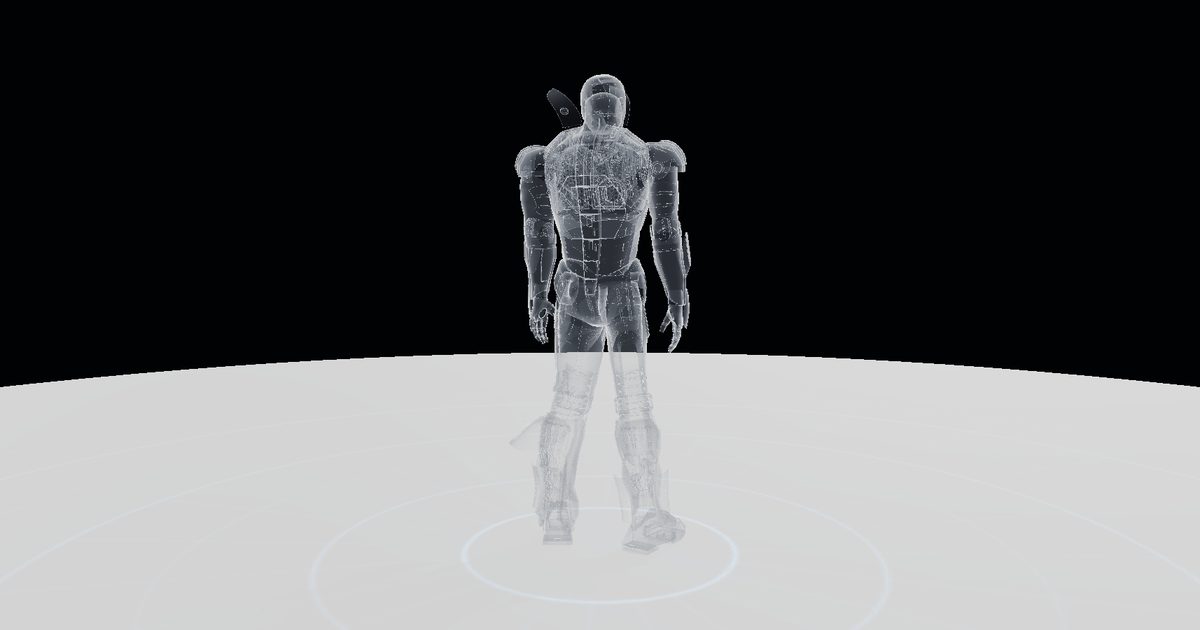
The short answer
A sealed suit has two heat problems, and a real design keeps them apart. The first is the wearer: a working human makes a few hundred watts and cannot sweat it away once the shell closes. NASA solved that decades ago with a water-cooled undergarment. The second is the machine: actuators, computers and above all jet engines, making kilowatts to megawatts. Nobody has solved that one in a body-sized package.
This guide covers the cooling hardware. The broader argument, that heat rather than power is the suit's real limit, is in our article the real enemy is heat.
Start with the human
NASA's Life Support Baseline Values and Assumptions Document gives the design figures. A reference crew member makes about 500 kJ per hour (139 W) at a nominal workload and 3,484 kJ per hour (968 W) during hard exercise at 75% of maximum aerobic capacity. Measured spacewalks average 950 kJ per hour (264 W) with peaks of 2,320 kJ per hour (644 W). NASA's EVA hardware overview lists the EMU spacesuit as designed for an average of 290 W and a maximum of 580 W.
The same NASA document shows why a closed suit is dangerous even at those modest numbers. During the second quarter-hour of hard exercise, the reference crew member's total heat output is 2,417 kJ per hour, and 1,953 kJ per hour of it, 81%, leaves as water vapor and sweat. That is the body's main cooling path. Seal the person inside a shell and the trapped air soon saturates, sweat stops evaporating, and the heat stays in.
The liquid cooling garment
The answer is to stop relying on air and put water against the skin. NASA's Spacesuit Guidebook describes the EMU's Liquid Cooling and Ventilation Garment: a one-piece stretch suit like long underwear, laced with 91.5 meters of plastic tubing that carries chilled water from the backpack.
Water is the right fluid because of how much heat it holds. Its volumetric heat capacity is about 4.18 MJ per cubic meter per kelvin, against about 1.2 kJ for air at room conditions, roughly 3,450 times more. The flow needed is small. With heat Q = flow x 4,180 J/kg·K x temperature rise, carrying 580 W with a 5 K rise in the water needs about 1.7 liters per minute. Even the 968 W hard-exercise figure needs only about 2.8 liters per minute, the job of a small brushless pump.
In the suit's design the garment is a separate crew loop, isolated from the equipment loop that cools the electronics, so a spike in the machine can never push hot fluid against the skin. The International Space Station follows the same rule at a larger scale: per NASA's thermal control overview, water loops run inside the modules, and the ammonia loops that carry heat to the radiators stay outside the pressurized volumes to prevent crew contact with ammonia.
Getting the heat out in vacuum: the sublimator
Collecting heat is the easy half. In space there is no air to dump it into, so the EMU throws away water instead. The Spacesuit Guidebook describes the trick: feedwater flows to a porous metal plate exposed to vacuum, freezes in the pores, and the ice sublimates straight into space, chilling the cooling loop on the other side of the plate. The harder the astronaut works, the faster the ice sublimates, so the system regulates itself.
The EMU carries 4.57 kg of feedwater. Turning ice into vapor takes about 2.83 MJ per kilogram: about 2.50 MJ to evaporate water near 0 C, per NIST's water data, plus about 0.33 MJ to melt it. So:
- 4.57 kg x 2.83 MJ/kg = 12.9 MJ of heat rejection.
- Spread over a 7-hour spacewalk, that is about 514 W, comfortably covering a suit designed for 290 W average and 580 W peaks.
The method scales badly. Rejecting just 5 kW of machine heat this way would boil off about 6.4 kg of water per hour. At the 3 gigajoules per second the 2008 film gives for the arc reactor, it would take about 1,060 kg of water per second.
Radiators: the ceiling in vacuum
The only way to lose heat in vacuum without spending mass is to radiate it, and radiation is slow at temperatures a person can touch. Using the Stefan-Boltzmann constant, a perfect emitter at 300 K (27 C) radiates 459 W per square meter, and a realistic surface with an emissivity of 0.9 radiates about 413 W. Sunlight and a planet's glow falling on the panel reduce the net figure further.
Real hardware confirms the scale. The ISS photovoltaic radiator rejects up to 14 kW from a deployed panel 3.12 m by 13.6 m (42.4 m²) that weighs 740.7 kg, according to the same NASA overview. That is about 330 W per square meter of panel and about 19 W per kilogram. At that ratio, one kilowatt needs about 3 m² of panel and 53 kg.
A human body offers about 2.0 m² of skin by the standard Du Bois formula (for a person 1.80 m tall and 80 kg), and much of a suit's exterior faces its own limbs rather than open space. The back plates, the one large flat area, carry the suit's radiator panels and can plausibly shed a few hundred watts in vacuum. That covers the human, not the machine.
Running the radiator hotter helps, because output rises with the fourth power of temperature: at 345 K (72 C) the same panel radiates about 723 W per square meter, 75% more than at 300 K.
Air: convection does the work, until speed turns against it
In the atmosphere the passing air is a far better heat sink than any panel. Standard flat-plate heat-transfer correlations, with textbook properties for 20 C air, a 0.5 m panel and a fully turbulent boundary layer at the two higher speeds, give:
| Airspeed | Heat-transfer coefficient | Heat shed per m² at a 20 K difference |
|---|---|---|
| 5 m/s (hover, slow drift) | about 12 W/m²·K | about 250 W |
| 30 m/s (about 108 km/h) | about 107 W/m²·K | about 2.1 kW |
| 100 m/s (about 360 km/h) | about 280 W/m²·K | about 5.6 kW |
Three things erode that advantage:
- Hovering. At walking-pace airflow, convection is no better than radiation. Hovering is also when the engines work hardest, so the worst heat load meets the weakest cooling.
- Altitude. At 10 km the air's density is about a third of sea level's, and the heat-transfer coefficient falls to roughly 42% (density to the power 0.8). The colder air at altitude only partly makes up for it.
- Ram heating. Air brought to rest against a surface heats up by v²/(2 x 1,005 J/kg·K). At 300 m/s that is about 45 K, and a panel's surface sees about 89% of it. On a 30 C day at 300 m/s, the shell's skin sits near 70 C before the suit makes any heat of its own. At Mach 3 high in the stratosphere (about 885 m/s), the rise is about 390 K. Past a few hundred meters per second, the airstream stops being a coolant and becomes a heater.
Moving the heat: heat pipes and pumped loops
A heat pipe is a sealed tube with a wick and a working fluid that evaporates at the hot end and condenses at the cold end. According to Advanced Cooling Technologies, heat pipes reach effective thermal conductivities of 10,000 to 100,000 W/m·K, against roughly 400 for solid copper, with no moving parts. Copper-water heat pipes typically work between 20 and 150 C, which fits a suit's electronics.
For larger loads, spacecraft use pumped fluid loops. The ISS's external system circulates ammonia, which freezes at -77 C, and is designed for 35 kW per loop and 70 kW in total, per NASA. A suit would use the same two-tier pattern: heat pipes for short passive runs from each hot component, a pumped loop for the long run to the back.
Transport is not the bottleneck. Heat pipes and pumps can move kilowatts across a suit easily; they cannot create a place to put it.
Buffering spikes: phase-change material
When the heat comes in bursts (a weapon firing, a hard climb), the suit can soak it up temporarily in a material that melts. NIST data for n-eicosane, a paraffin used in thermal research, gives a melting point of about 310 K (37 C) and an enthalpy of fusion of about 69.9 kJ/mol. With a molar mass of 282.5 g/mol, that is about 247 kJ per kilogram, absorbed at a constant temperature.
- A 10 kW burst for 60 seconds (600 kJ) melts about 2.4 kg.
- A 100 kW burst for 10 seconds (1 MJ) melts about 4 kg.
Melting near body temperature, eicosane suits the equipment loop rather than anything against the skin. It is a buffer, not a sink: every joule it stores must be rejected later, before the next burst.
Peltier devices: a heat pump that adds heat
A Peltier module pumps heat electrically from one face to the other with no moving parts. It sounds ideal for a suit, but it is expensive in power. The Pacific Northwest National Laboratory's review of cooling technologies puts current thermoelectric devices at 10 to 15% of the ideal Carnot efficiency (a coefficient of performance of about 1 to 1.5 in its building-cooling case), with materials whose figure of merit ZT is around 1.0. Ordinary vapor-compression machines reach 40 to 60% of Carnot.
- Cooling a 15 C loop and rejecting at 45 C, the ideal Carnot COP is 288 / 30 = 9.6. At 10 to 15% of that, a real module manages about 1.0 to 1.4.
- At a COP of 1, pumping the wearer's 580 W takes another 580 W of electricity, and the hot side must dump 1,160 W, twice the original load.
So a Peltier never reduces the heat the suit must reject. It earns its place only when the surroundings are too hot to reject heat at skin-safe temperatures. On a 40 C day, a radiator at 45 C has almost no driving difference; a heat pump lifting the hot side to 72 C restores it. It trades power for temperature, and power is the one thing the fiction has in abundance. A miniature vapor-compression loop would do the same job roughly four times more efficiently, at the price of a compressor.
The boots: turbine exhaust and thermal barrier coatings
The hottest thing near the wearer is the propulsion. The closest real engines to boot thrusters are small turbojets. JetCat's P400-PRO makes 425 N of thrust with an exhaust gas temperature of 480 to 750 C, an exhaust velocity of 2,122 km/h and a mass flow of 0.67 kg/s, burning 1,392 ml of fuel per minute.
Put that in power terms. At typical jet-kerosene values (about 0.8 kg per liter and 43 MJ per kilogram), 1,392 ml per minute is about 0.8 MW of fuel. The jet's kinetic power, ½ x 0.67 kg/s x (589 m/s)², is about 116 kW, so roughly 680 kW per engine leaves as heat. A 150 kg suit and wearer needs 150 x 9.81 = 1,470 N to hover, about 3.5 such engines and about 2.4 MW of heat. Nearly all of it leaves in the plume, but if just 1% soaked into the suit, that would be 24 kW, about 40 times the wearer's own peak output.
Jet engines survive their own heat with thermal barrier coatings of yttria-stabilized zirconia. In NASA Glenn tests reported in NASA TM-2004-212961, coatings with a 1,316 C surface kept the metal interface at about 950 to 1,100 C, a drop of 216 to 366 C. The baseline zirconia coating started at a thermal conductivity of about 1.0 W/m·K and rose to about 1.4 after 20 hours of high-heat-flux testing as the ceramic sintered.
Those numbers carry a lesson. By Fourier's law, a coating with a conductivity of 1.0 W/m·K that is 0.5 mm thick and holds back 300 K still passes about 600 kW per square meter. A coating lowers the metal's temperature only because something behind it, cooling air in a turbine blade, carries that flux away. In a boot, the coolant would be the suit's own equipment loop. So the real design keeps the plume from touching the shell at all: nozzles that extend clear of the foot, an air gap, a coating on the inner liner, and a reflective outer skin, which is the actual job of the gold layer.
The fiction against today's best hardware
| Job | In the films | Best real technology | Real figure |
|---|---|---|---|
| Remove the wearer's heat | Never shown as a limit | NASA EMU liquid cooling garment | Designed for 290 W average, 580 W peak; 91.5 m of tubing |
| Dump heat in vacuum | Flies into space (2012 film) | EMU sublimator | 4.57 kg of water, about 12.9 MJ, about 514 W over 7 hours |
| Radiate to space | Not shown | ISS photovoltaic radiator | 14 kW from 42.4 m² and 740.7 kg: about 330 W/m², 19 W/kg |
| Move heat | Not shown | Heat pipes, pumped ammonia loops | 10,000 to 100,000 W/m·K; 35 kW per ISS loop |
| Buffer spikes | Not shown | Paraffin phase-change material | About 247 kJ/kg at 37 C (n-eicosane) |
| Pump heat uphill | Not shown | Bismuth-telluride Peltier | 10 to 15% of Carnot, versus 40 to 60% for vapor compression |
| Survive exhaust | Boot jets next to the feet | YSZ thermal barrier coating | 1,316 C surface to 950 to 1,100 C metal; k of 1.0 to 1.4 W/m·K |
| Total heat to reject | 3 GJ per second reactor (2008 film) | All of the above combined | Kilowatts in air, hundreds of watts in vacuum |
The verdict
Keeping the wearer cool is a solved problem. A liquid cooling garment, a small pump and a sublimator or radiator handle a working human's 300 to 600 W, as on every NASA spacewalk. That layer of the 3D teardown is as real as any part of the suit.
Keeping the machine cool is not. Moving heat is easy, buffering bursts and pumping heat uphill are possible at a cost, and getting rid of it is the wall: about 330 W per square meter of radiator in space, a few kilowatts per square meter of airflow at speed, almost nothing in a hover, and a hot shell from ram heating at high speed. A real suit would fly in short, fast bursts in cool air, with its engines' heat leaving in the plume and its wearer in a separate, protected loop. For the rest of the machine, see the guides on the arc reactor, flight, life support and the full engineering hub.
FAQ
How does a spacesuit keep an astronaut cool?
Chilled water runs through 91.5 m of tubing in a garment against the skin, then past a sublimator, where ice evaporates through a porous plate into vacuum and carries the heat away.
Why can't the suit just use air conditioning?
An air conditioner moves heat rather than destroying it, and adds its own power as heat. In a hover, in vacuum or on a hot day, there is little capacity outside the suit to take it.
Would a Peltier cooler work in the suit?
Poorly. Thermoelectric modules reach only 10 to 15% of the ideal efficiency, so pumping 580 W of body heat can double what the suit must reject. They pay off only when the surroundings are hotter than the skin.
How hot is jet exhaust near the boots?
A 425 N small turbojet exhausts at 480 to 750 C. Zirconia thermal barrier coatings can hold metal a few hundred degrees cooler, but only if a coolant behind them carries the heat away.
Is flying fast good or bad for cooling?
Both. Faster air carries away far more heat, about 5.6 kW per square meter at 100 m/s against 250 W at hover speed. But at a few hundred meters per second, ram heating warms the shell so much that the air starts adding heat instead of removing it.