How strong would a real Iron Man suit be?
Updated 2026-11-23 · 4 min read
Short answer
About as strong as today's best exoskeleton, the Sarcos Guardian XO, which makes a 90 kg load feel like 4.5 kg, a 20 to 1 boost. Lifting a 1,500 kg car is possible in principle: hydraulics supply the force and about 15 kilowatts lifts it in a second. But held at arm's length it needs ten times the torque any real exoskeleton joint makes and would tip the suit onto its face, so a real suit could only lift a car overhead, slowly, on firm ground.
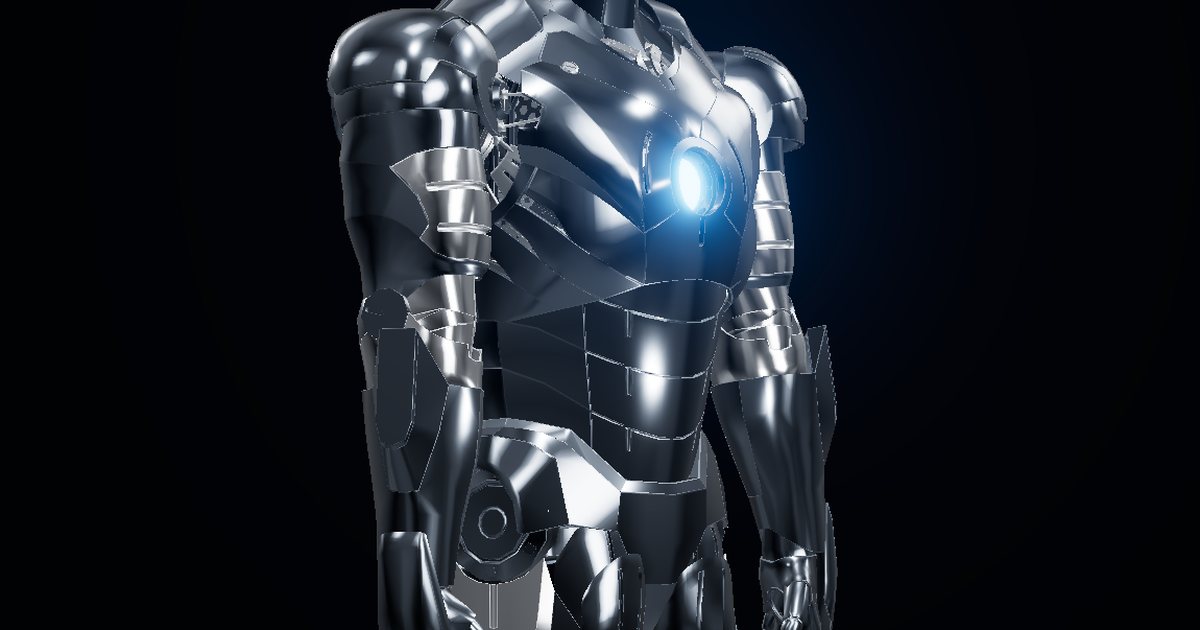
What the stories claim, and what real suits do
In the films the suit tosses cars and holds up heavy machinery, and fan references to Marvel's handbooks put the armor in the 100-ton lifting class. Those are story numbers.
The real benchmark is the Sarcos Guardian XO, the best-documented full-body powered exoskeleton ( exoskeleton guide). It weighs 68 kg, carries its own weight, and makes a 90 kg load feel like 4.5 kg to its wearer: a 20 to 1 strength boost. Its strongest joints peak at about 450 N·m of torque.
So the question is not whether a suit can make its wearer stronger. It already can. The question is how far that scales, and the answer comes down to four numbers: torque, force, power and balance.
Lifting a car: the four limits
Take a 1,500 kg car, a weight of 1,500 × 9.81 = 14,700 N.
1. Torque at the shoulders
Held out in front at arm's length, about 0.6 m from the shoulders, the car makes a turning load of 14,700 × 0.6 = 8,830 N·m, or about 4,400 N·m per shoulder. That is ten times the Guardian XO's 450 N·m peak. Electric motors with gearboxes, the way the XO is built, are nowhere near this at a size that fits a shoulder.
2. Force: hydraulics can do it
Hydraulic cylinders are how excavators and aircraft move heavy loads. Aircraft hydraulic systems commonly run at 3,000 psi (20.7 MPa). A cylinder 4 cm across has a piston area of π × 0.02² = 0.00126 m², so it pushes 20.7 MPa × 0.00126 m² = 26,000 N, more than the car's whole weight, from one cylinder narrower than a soda can. Force is the easy part. The price is a pump, hoses, heat and high-pressure fluid next to a person.
3. Power: a small engine's worth
Raising the car 1 m in one second takes 14,700 N × 1 m ÷ 1 s = 14.7 kW, about the output of a small motorbike engine and 30 times the Guardian XO's 500 W walking budget. A battery can deliver that in a short burst, so a lift is possible; doing it again and again drains the suit fast. Lifting slowly, over ten seconds, cuts the power to 1.5 kW.
4. Balance: the real limit
A suit stays upright only while the center of mass of everything it holds stays over its feet. Suit and wearer together come to about 280 kg (a 200 kg rifle-proof suit from the weight guide and an 80 kg wearer). Hold a 1,500 kg car 0.6 m in front of the body and the combined center of mass moves (1,500 × 0.6) ÷ 1,780 = 0.51 m forward, far beyond the toes of a boot. The suit falls on its face.
There are only three ways out: brace against something, carry a counterweight several times heavier than the suit, or do what a weightlifter does and get the load over the head, where it sits above the feet. A real suit could lift a car overhead. It could not hold one out in front.
What the ground has to carry
Overhead, all 1,780 kg goes down through two boot soles of about 0.03 m² each: 1,780 × 9.81 ÷ 0.06 = 291 kPa, a little more than a car tire presses on the road. Firm ground takes it; grass and sand would let the boots sink.
The comics' 100 tons on the same two soles would be 100,000 × 9.81 ÷ 0.06 = 16 MPa, about 80 times a tire's pressure. The suit would sink into asphalt and soil, and ordinary concrete, rated around 20 to 40 MPa, would be close to crushing under the edges of the boots.
The wearer inside
A good suit carries the load through its own frame to the ground, so the wearer's spine never feels the car. What the wearer does feel is control. At 20 to 1, a small mistake in the suit's reading of its wearer's intent becomes a large, fast movement, which is why real exoskeletons limit speed and range and stop when the readings disagree. A suit strong enough to lift a car would need the same caution scaled up tenfold.
The verdict
A real suit could make its wearer roughly 20 times stronger with today's exoskeleton technology, enough to carry 90 kg as if it weighed 4.5 kg. With hydraulics in the arms and a burst of about 15 kW, it could even press a car overhead on firm ground. It could not hold a car out in front, throw one, or lift anything close to the comics' 100 tons: balance and the ground give out long before the metal does. For how the suit would read its wearer's movements in the first place, see the exoskeleton guide; for the power behind a lift, the arc reactor guide.
The numbers behind this page
- Car: 1,500 kg. Suit 200 kg, wearer 80 kg. Arm's length 0.6 m. Boot sole about 0.03 m² each.
- Guardian XO: 68 kg, 90 kg load felt as 4.5 kg, about 450 N·m peak joint torque, about 500 W walking ( IEEE Spectrum, 2019).
- Hydraulics: 3,000 psi (20.7 MPa), the common operating pressure of aircraft hydraulic systems.