What would a real Iron Man suit be made of?
Updated 2026-11-23 · 14 min read
Short answer
Not one gold-titanium alloy but a stack of materials: a Ti-6Al-4V titanium frame, boron carbide or silicon carbide strike plates backed by polyethylene or aramid fiber, and gold only as a film about 100 nanometers thick. Real rifle-rated plate weighs about 41 to 45 kg per square meter, so armoring the whole body adds roughly 100 kg before a single motor or thruster.
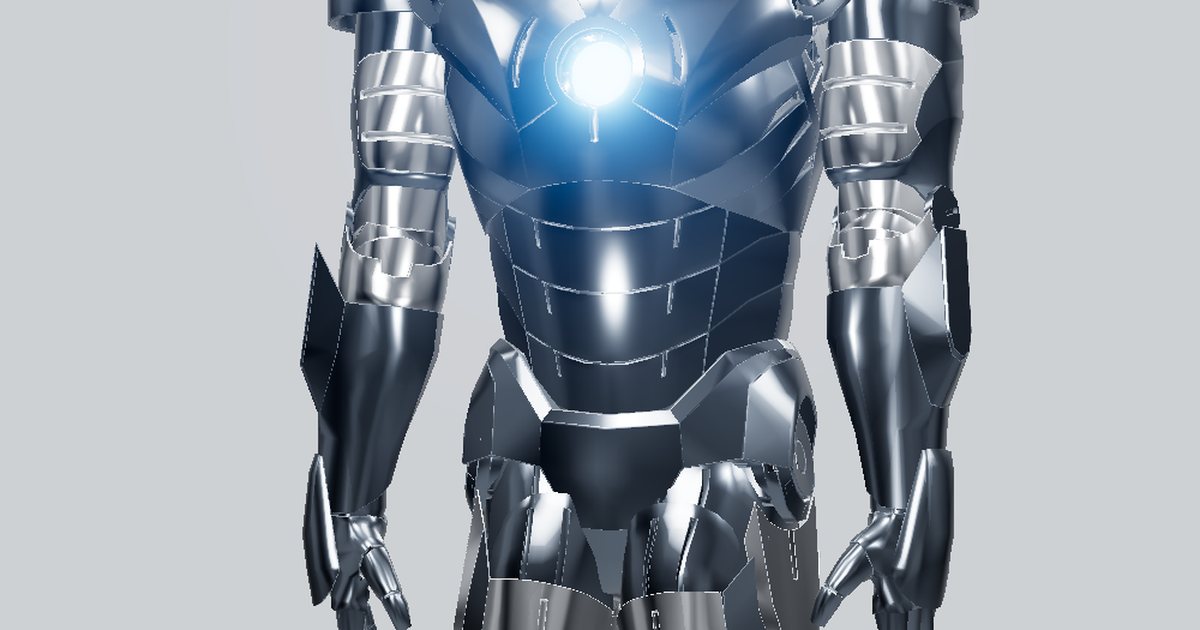
The short answer
The films give the suit one miracle material, a "gold-titanium alloy" that is light, bulletproof and immune to the cold. Real engineering splits that into separate jobs done by separate materials:
- Structure: Ti-6Al-4V titanium, the standard aerospace alloy, for the frame and the load-carrying shell.
- Stopping bullets: a hard ceramic strike face (boron carbide or silicon carbide) bonded to a fiber backing (polyethylene or aramid).
- Blunt force: padding that spreads the blow, including shear-thickening materials.
- Heat: gold, but only as a reflective film about 100 nanometers thick, the same coating NASA puts on a space telescope.
Do it honestly and rifle-rated armor over the whole body comes out near 100 kg. The plates this guide covers are mapped part by part in the 3D teardown, and the frame that has to carry them is covered in the exoskeleton guide.
What 'gold-titanium alloy' means in the films
In the 2008 film, the first flight-test suit ices up at high altitude and falls, and the fix is to rebuild the shell from a gold-titanium alloy borrowed from a satellite design. From then on the material does everything at once.
A titanium-gold compound really exists, and it is remarkable. In 2016 a team led by Rice University physicists reported in Science Advances that the intermetallic compound beta-Ti3Au (three titanium atoms for every gold atom) reaches a Vickers hardness of about 800 HV, roughly 7.8 GPa. That is about four times pure titanium and on par with the hardest high-carbon steels. It also slid with a friction coefficient below 0.15, against about 0.35 for titanium, cut wear volume by about 70%, and passed cell-viability tests. The intended use is joint replacements and other implants.
Two things keep it from being armor plate. The first is weight. The paper gives the cubic cell as about 5.1 angstroms on a side, and in the beta structure that cell holds six titanium atoms and two gold atoms:
- mass of one cell: (6 × 47.87 + 2 × 196.97) g/mol ÷ 6.022 × 10^23 per mol = 1.13 × 10^-21 g
- volume of one cell: (5.1 × 10^-8 cm)^3 = 1.33 × 10^-22 cm³
- density: about 8.5 g/cm³, nearly double Ti-6Al-4V and heavier than iron at 7.87 g/cm³
The second is that hardness is not toughness. Armor has to soak up energy without shattering, and a hard intermetallic has never been proven as a structural plate. Where Ti3Au makes sense is as a wear coating on the joints, bearings and sliding plate edges. Right material, wrong job.
Titanium: the frame, not the shield
Ti-6Al-4V (Grade 5 titanium) is the alloy of jet-engine parts and airframe fittings, and it is the honest choice for the suit's frame and outer shell. AZoM's property data gives it a density of 4.43 to 4.51 g/cm³, a tensile strength of 862 to 1,200 MPa depending on heat treatment, an elastic limit of 786 to 910 MPa, a stiffness of 110 to 119 GPa and a melting range of about 1,605 to 1,660 °C. That is most of the strength of a high-tensile steel at a little over half the weight, and it does not rust.
Take a shell 3 mm thick over 2.4 m² (the suit's outer area, worked out below): 2.4 m² × 0.003 m = 7,200 cm³ of metal.
| A 3 mm shell over 2.4 m² | Density (g/cm³) | Mass |
|---|---|---|
| Ti-6Al-4V | 4.43 | 32 kg |
| Beta-Ti3Au | about 8.5 | 61 kg |
| Solid gold | 19.3 | 139 kg |
The shell is also not where the bullet stops. A 2026 review in Molecules notes that ceramics with densities of 2.5 to 4.0 g/cm³ "offer significant weight advantages" over steel armor, which is why rifle plates are built around ceramic rather than metal.
Gold's real job: a heat mirror
There is a real reason to put gold on a suit, and it is not strength. Gold reflects infrared light extremely well, which is why NASA coats the James Webb Space Telescope's mirrors with it. NASA gives that layer as 1,000 angstroms, or 100 nanometers, thick.
Put the same film on the suit's 2.4 m² of outer surface:
- volume: 2.4 m² × 100 × 10^-9 m = 2.4 × 10^-7 m³ = 0.24 cm³
- mass: 0.24 cm³ × 19.3 g/cm³ = about 4.6 g
Under five grams of gold gives the whole shell an infrared-reflective skin that turns away radiant heat from sunlight and hot exhaust: a thermal coating, not armor. Heat is the suit's hardest problem by a wide margin, as the cooling guide and the article The real enemy is heat explain.
Ceramics: what actually stops a rifle bullet
Rifle plates work in two stages: a hard ceramic face shatters and erodes the bullet's tip and spreads the load, then a tough fiber backing catches the fragments. The three ceramics that matter, from the National Academies' 2011 report on Army protection materials (Table E-1, commercial armor grades; the last column converts its pounds per square foot to kilograms):
| Ceramic | Density (g/cm³) | Knoop hardness, 2 kg load | Fracture toughness (MPa·m½) | Weight of a 1-inch tile (kg/m²) |
|---|---|---|---|---|
| Boron carbide (B4C) | 2.50 to 2.51 | 1,997 to 2,066 kg/mm² (about 20 GPa) | 2.5 to 3.1 | 63 |
| Silicon carbide (SiC) | 3.02 to 3.25 | 1,873 to 1,969 kg/mm² (about 19 GPa) | 4.0 to 6.4 | 77 to 82 |
| Alumina (Al2O3) | 3.90 | 1,292 kg/mm² (about 12.7 GPa) | 4 to 5 | 99 |
Boron carbide is the lightest and hardest of the three. On a low-load Vickers test, one grade in the same table measures 3,200 kg/mm², about 31 GPa. It also has a known weakness. The report's chapter on ceramics notes that boron carbide has the highest Hugoniot elastic limit of any ceramic, about 17 to 20 GPa, but that once impact pressures pass about 20 GPa its shear strength drops abruptly, and electron microscopy finds amorphous bands 2 to 3 nm wide inside the grains. In plain terms, the fastest, hardest armor-piercing cores can make it lose its crystal order and fail early.
Silicon carbide is the answer to that. The Molecules review states that it "does not undergo amorphization" under high dynamic pressure, it is tougher (and toughness, the review notes, is what governs multi-hit durability), and it costs less than boron carbide. So a sensible suit uses boron carbide on the chest and back, where every gram counts, and silicon carbide on the limbs, shoulders and anywhere likely to take more than one round.
Fibers: the catcher behind the ceramic
Two fiber families dominate the backing. Aramid, best known as Kevlar, has an actual fiber density of about 1.45 g/cm³ ( National Academies, Appendix F), and Kevlar 49 reaches a tensile strength of 3.6 GPa with 2.7% stretch before it breaks (Table E-2). Ultra-high-molecular-weight polyethylene (UHMWPE, sold as Dyneema and Spectra) is lighter still at about 0.97 g/cm³, light enough to float. The US Army Research Laboratory describes UHMWPE as having higher tensile strength and lower density than aramid, and its maker claims it is 15 times stronger than steel at equal weight and 35% lighter than aramid at equal stopping power (a manufacturer figure).
Table E-2 also shows why fibers do this job: what matters is toughness, the energy absorbed before failure. Kevlar 49 absorbs about 50 MJ/m³, carbon fiber about 25 and high-tensile steel only about 6. Carbon fiber is stronger (4 GPa) and stiffer, but it snaps at 1.3% strain, so it belongs in structural panels, not the layer that stops fragments.
Shear-thickening padding and blunt trauma
Even a plate that stops the bullet passes its momentum into the wearer. Under NIJ Standard 0101.06, armor passes only if the dent it leaves in a clay block behind it, the backface signature, is no deeper than 44 mm (1.73 in). Armor doing its job can still push in more than 4 cm.
Spreading that blow is the padding's job, and the most interesting option is shear-thickening fluid: hard particles (usually silica) suspended in a liquid such as polyethylene glycol, which flows when moved slowly and stiffens almost instantly when struck. University of Delaware and US Army Research Laboratory researchers showed in 2003 that soaking Kevlar fabric in it changes how the fabric resists a ballistic impact, and a 2022 review in Polymers traces two decades of follow-up work aimed at lighter, more flexible soft armor. It has a ceiling: a 2013 study found the fluid loses its ballistic resistance at higher impact velocities, limited by the strength of the particles in it. In a suit it is a flexible under-layer that firms up under a blow. It does not replace the ceramic.
What real armor ratings mean
US body armor is rated by the National Institute of Justice. Its current standard, NIJ 0101.07, was published on November 1, 2023, as a revision of the 2008 standard 0101.06, and the threat levels now live in a companion document, NIJ 0123.00. Energy is E = ½mv², with 1 grain = 0.0648 g:
| Level (old name) | Key test round | Bullet mass | Velocity | Energy |
|---|---|---|---|---|
| HG1 (Level II) | .357 Magnum JSP, 158 gr | 10.2 g | 436 m/s | about 970 J |
| HG2 (Level IIIA) | .44 Magnum JHP, 240 gr | 15.6 g | 436 m/s | about 1,480 J |
| RF1 (Level III) | 7.62x51mm M80 ball, 149 gr | 9.7 g | 847 m/s | about 3,460 J |
| RF2 (new level) | RF1 rounds plus 5.56mm M855, 61.8 gr | 4.0 g | 950 m/s | about 1,810 J |
| RF3 (Level IV) | .30-06 M2 armor-piercing, 165.7 gr | 10.7 g | 878 m/s | about 4,140 J |
The scale stops at RF3. Nothing on it covers the explosions and heavy weapons the suit absorbs in the films. Those are vehicle-armor problems.
How much real armor weighs
Real plates at the top of that scale:
- Point Blank's Paraclete 10082, a ceramic-composite Level IV stand-alone plate, 10 by 12 inches and 0.8 inch thick: about 7.3 lb (3.3 kg).
- Point Blank's LV 7200, ceramic over backing fiber, listed against .30-06 M2 AP, 1 inch thick: 7.0 lb (3.2 kg) single-curve, 7.7 lb (3.5 kg) multi-curve.
A 10 by 12 inch plate covers 0.0774 m², so:
- 3.2 kg ÷ 0.0774 m² = 41 kg/m²
- 3.5 kg ÷ 0.0774 m² = 45 kg/m²
A front and back pair, the way rifle plates are normally worn, weighs about 6.4 to 7.0 kg and covers little more than the heart and lungs.
What the whole suit would weigh
Now cover everything. Skin area can be estimated with the Mosteller formula: area = √(height in cm × mass in kg ÷ 3,600). For a 180 cm, 80 kg wearer that is √(180 × 80 ÷ 3,600) = 2.0 m². The armor sits off the skin over padding and a frame, so its outer surface is larger. Assume 20% more, or 2.4 m².
- Rifle plate (RF3 class) everywhere: 2.4 m² × 41 to 45 kg/m² = 98 to 108 kg
- Gold thermal film: about 5 g
- Frame and actuators: Sarcos's Guardian XO full-body exoskeleton weighs about 150 lb (68 kg) to carry 200 lb (90 kg), so a frame for 100 kg of armor is at least that heavy.
- Batteries: the Guardian XO's two 500 Wh packs weigh 12 lb (5.4 kg) each, for about two hours of work.
Add it up: roughly 100 kg of armor and 70 kg or more of frame, motors and batteries put a rifle-proof suit near 170 to 200 kg empty, or about 250 to 280 kg with its wearer ( how much the Iron Man suit weighs breaks that down system by system). Hovering 280 kg takes 280 × 9.81 = about 2,750 N of continuous thrust, which the flight guide shows is already at the edge of anything body-worn.
This is why real programs armor selectively. US Special Operations Command spent at least $80 million over five years on its TALOS armored suit and in 2019 said it had no intent to field it. One piece that did mature was lightweight polyethylene armor.
The materials at a glance
| Material | Density (g/cm³) | Strength or hardness | Job in a real suit |
|---|---|---|---|
| Ti-6Al-4V titanium | 4.43 to 4.51 | 862 to 1,200 MPa tensile | Frame, structural shell, mounts |
| Beta-Ti3Au | about 8.5 (calculated) | about 800 HV (7.8 GPa), 4x pure titanium | Wear coating on joints and sliding edges |
| Gold film | 19.3 | none needed, 100 nm thick | Infrared-reflective thermal skin |
| Boron carbide | 2.50 to 2.52 | about 20 GPa Knoop, toughness 2.5 to 3.1 MPa·m½ | Lightest strike face, chest and back |
| Silicon carbide | 3.02 to 3.25 | about 19 GPa Knoop, toughness 4.0 to 6.4 MPa·m½ | Multi-hit and armor-piercing zones |
| Alumina | 3.90 | about 12.7 GPa Knoop | Cheapest, heaviest strike face |
| Aramid (Kevlar 49) | about 1.45 | 3.6 GPa tensile, 50 MJ/m³ toughness | Soft armor, spall liner |
| UHMWPE (Dyneema) | about 0.97 | stronger than aramid per the Army Research Laboratory | Plate backing, soft armor |
| Shear-thickening fluid | varies | stiffens on impact | Flexible blunt-force under-layer |
The fiction against the best real technology
| In the films | Best real technology today | Real figure | |
|---|---|---|---|
| Shell material | One gold-titanium alloy does everything | Titanium frame, ceramic face, polyethylene backing | Ti-6Al-4V at 4.43 g/cm³, B4C at 2.52 g/cm³ |
| The gold | Structural alloy | Infrared-reflective film | 100 nm thick, about 5 g for the whole suit |
| Titanium-gold | Satellite-grade armor | Beta-Ti3Au implant coating | 4x harder than titanium, about 8.5 g/cm³ |
| Bullet protection | Shrugs off gunfire, explosions, heavy weapons | RF3 rifle plate | One .30-06 AP round, about 4.1 kJ |
| Weight of protection | Light enough to fly and sprint | RF3 plates over the whole body | 41 to 45 kg/m², about 100 kg total |
| Blunt force | Wearer walks away | NIJ backface limit | Up to a 44 mm dent counts as a pass |
The verdict
Most of the suit's armor is buildable from parts that exist today. Titanium for the frame, ceramics and polyethylene for the plates, a shear-thickening under-layer and a gold film for heat are all real, shipping materials, and the layering is the same logic as a modern rifle plate. Even the films' gold-titanium alloy has a real counterpart, as long as it stays a wear coating.
Two things stay fictional. The first is weight: protection against rifle fire costs about 41 to 45 kg for every square meter covered, so full coverage is around 100 kg before the machine that carries it. The second is the ceiling: no wearable armor is rated past a single armor-piercing rifle round, and the hits the suit takes on screen are a job for armored vehicles. A real suit would be either heavy and slow, or selectively armored and vulnerable. For the rest of the machine, see the engineering hub.
FAQ
Is the Iron Man suit made of a real gold-titanium alloy?
A real titanium-gold compound, beta-Ti3Au, was reported in 2016. It is about four times harder than pure titanium, but at about 8.5 g/cm³ it is too heavy for a shell. It suits implant and joint coatings, not armor plate.
What is the best material for a real Iron Man suit?
No single material. Ti-6Al-4V titanium for structure, boron carbide or silicon carbide for the strike face, UHMWPE or aramid fiber behind it, a shear-thickening pad under that, and a 100 nm gold film on top for heat.
How much would a bulletproof Iron Man suit weigh?
Rifle plates weigh 41 to 45 kg per square meter, and a suit's outer surface is about 2.4 m², so the armor alone is about 100 kg. With a frame, motors and batteries, expect around 170 to 200 kg empty.
Would the wearer feel a bullet hit?
Yes. NIJ testing passes armor that leaves a dent up to 44 mm deep in clay behind it. Padding spreads that blow, but stopping a 4 kJ rifle round still lands a hard blow.
Why is the suit gold?
In the real version, for heat. Gold is an excellent infrared reflector, which is why NASA coats the Webb telescope's mirrors with a 100 nm layer of it. Covering the whole suit the same way would take under five grams.