How would Iron Man's HUD and sensors work?
Updated 2026-11-23 · 14 min read
Short answer
Most of it exists today in pieces: the F-35 helmet already shows a 30 by 40 degree display fed by six sensors around the jet, headsets redraw the world within 12 milliseconds, and thumb-sized thermal cameras run on 150 milliwatts. The hard limits are latency, field of view, the heat from onboard compute, and the human, since the best implanted brain interfaces decode about 62 words per minute.
What the films show
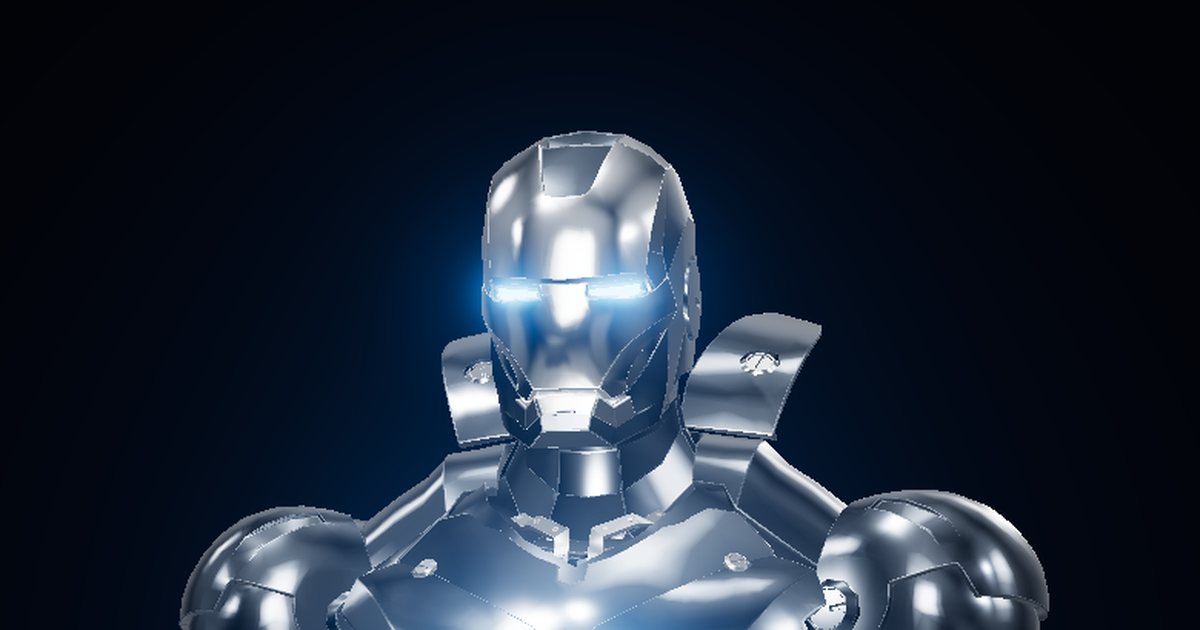
In the films, the inside of the helmet is a wraparound display. Targets are boxed and tracked, power and damage readouts hang at the edges, and maps and scans float in front of Tony Stark's face while a conversational assistant, J.A.R.V.I.S. and later F.R.I.D.A.Y., answers in real time. The suit locks many targets at once, Stark talks to it in the middle of a fight, and in Iron Man 3 he calls armor pieces to him through implants in his arms.
Every one of those has a real counterpart, and most are already in service: a fighter pilot's helmet and its sensor sphere, consumer mixed-reality headsets, eye tracking, fused navigation, voice assistants and neural interfaces. What separates the films from reality is not whether each piece exists. It is how fast, how big and how hot each piece is. The parts sit in the head, chest and back of the 3D teardown.
The F-35 helmet is the closest real thing
The nearest real HUD is the F-35's Gen III Helmet Mounted Display System. Collins Aerospace, which builds it with Elbit, lists a bi-ocular 30 by 40 degree field of view with 100 percent overlap between the eyes. At night it projects night vision straight onto the visor, so the pilot needs no separate goggles, and it lets the pilot target weapons by looking at a target and designating it. That is the films' look-to-lock, already in service.
Feeding the helmet is the Distributed Aperture System, the AN/AAQ-37, which the F-35 program office describes as six electro-optical sensors forming a 360 degree, spherical view around the aircraft. Their images are fused into one seamless picture, so the helmet can show the outside view in whichever direction the pilot looks. The range is long because hot things glow brightly in infrared: in 2010 Northrop Grumman reported that a DAS flying on a BAC 1-11 test aircraft detected and tracked a two-stage rocket launch more than 800 miles (about 1,290 km) away, from horizon break to final burnout.
A suit changes one thing. There is no canopy. The faceplate is the visor, so the glowing eye slits in the films are cosmetic, and the real view has to come from cameras on the armor, a video passthrough. That makes the camera, not the glass, the start of the delay chain. It also means 30 by 40 degrees is a window, not a wraparound: the films' full-face display is still well beyond any fielded helmet.
AR headsets and eye tracking
Consumer headsets now do much of what the films show. Apple's Vision Pro packs 23 million pixels into two postage-stamp-sized micro-OLED displays, and its R1 chip processes input from 12 cameras, five sensors and six microphones and streams new images to the displays within 12 milliseconds. It is controlled by eyes, hands and voice: you look at something and tap your fingers to select it.
At the light end, Meta Ray-Ban Display puts a full-color display into a pair of glasses with up to six hours of mixed use, sold from $799 together with the Meta Neural Band, an EMG wristband that turns muscle signals at the wrist into commands. A suit would use the same pairing: a display in front of the eye, and intent read from the body instead of from buttons.
Eye tracking is the refinement a suit would add to the fighter approach. A helmet knows where the head points. An eye tracker knows where the eyes point, which lets the reticle follow a glance instead of a head turn, and lets the display render full detail only where the wearer is actually looking.
Motion-to-photon latency
Motion-to-photon latency is the time between moving your head and the display showing the world from the new angle. A 2026 Meta Reality Labs study puts modern headsets at 12 to 60 milliseconds. Using a custom passthrough headset with just 2 ms of delay, it found that 57 participants trying to catch a ball preferred 2 and 14.3 ms over 23 and 29 ms. The industry target of about 20 ms is a rule of thumb, and the data say lower is better.
The math shows why. Turn your head at 100 degrees per second, a brisk glance, and a symbol meant to sit on a target trails behind it by speed times delay:
- 20 ms × 100°/s = 2° of error, 5 percent of the F-35 display's 40 degree width
- 12 ms, Vision Pro's figure = 1.2°
- 2 ms, the research prototype = 0.2°
The suit adds its own motion. At 300 m/s it covers 6 m in 20 ms, so anything pinned to the world has to be predicted ahead, not just drawn quickly. Because the suit sees through cameras, its latency also includes exposure, readout, stitching and rendering, which is why a dedicated chip like Apple's R1 handles that path rather than a general processor.
Fiction against the best real technology
| Capability | In the films | Best real technology today |
|---|---|---|
| Display | Full-face wraparound | F-35 Gen III HMDS: 30 × 40 degrees, 100 percent binocular overlap, night vision on the visor |
| Display delay | Instant | Vision Pro: 12 ms; research prototype: 2 ms; typical headsets: 12 to 60 ms |
| All-round vision | Sees in every direction | F-35 DAS: six sensors, 360 degree sphere, rocket tracked at more than 800 miles |
| Heat vision | Instant thermal view | FLIR Lepton 3.5: 160 × 120 pixels on 150 mW |
| Assistant response | Instant conversation | GPT-4o: as little as 232 ms, 320 ms on average |
| Thought control | Implants summon armor | Implanted speech interface: 62 words per minute; EMG wristband handwriting: 20.9 words per minute |
| Onboard compute | Unlimited and invisible | NVIDIA Jetson Thor: up to 2,070 FP4 TFLOPS at 40 to 130 W |
Sensors: what fits on a suit
The films show the suit sensing everything at once. Real sensors trade range against size and power, and the useful question is what each one costs to carry.
| Sensor | Real example | Size and mass | Power | What it gives the suit |
|---|---|---|---|---|
| Thermal camera | Teledyne FLIR Lepton 3.5 | 10.5 × 12.7 × 7.2 mm | 150 mW typical | A 160 × 120 pixel heat image that works in total darkness |
| LIDAR | Livox Mid-360 | 65 × 65 × 60 mm, 265 g | 6.5 W average | 200,000 points per second, 360 degrees horizontally, 40 m on dark targets (10 percent reflectivity), 70 m on bright ones |
| Radar | Texas Instruments IWR6843 | 10.4 × 10.4 mm chip | Not listed on the product page | A full 60 to 64 GHz radar with 3 transmit and 4 receive channels on one chip |
| Infrared sphere | F-35 AN/AAQ-37 DAS | Six sensors spread over the airframe | Not published | Passive 360 degree detection and tracking at very long range |
Thermal is nearly free: six Lepton-class cores, one per direction, draw about 0.9 W in total. The catch is resolution. 160 × 120 is 19,200 pixels, against 23 million in Vision Pro's displays, so thermal is a detector and a night view, not a sharp picture.
LIDAR gives the suit a 3D map of everything within tens of meters, which is what landing, dodging obstacles and flying indoors need. Radar sees through smoke and fog, but the radar equation is harsh. The echo weakens with the fourth power of range, because the signal spreads out on the way to the target and again on the way back, so doubling range takes 16 times the power or a much bigger antenna. That is why a fighter's radar fills its nose cone. A suit's chest panel holds a chip and a flat antenna, which makes radar a short-range sensor for obstacles, ground clearance and close targets. Long range comes passively, from infrared, the way the DAS does it.
Sensor fusion and navigation
Each sensor is wrong in its own way. An inertial measurement unit (gyroscopes and accelerometers) answers in microseconds but drifts. Satellite navigation (GNSS) gives absolute position but updates slowly and can be jammed. LIDAR and cameras give precise position relative to nearby objects but see only what is in view. Sensor fusion, usually a Kalman filter, predicts motion from the fast sensor and corrects it with the slow ones, weighting each by how much it can be trusted at that moment.
The drift is why the correction is not optional. Position comes from integrating acceleration twice, so a constant accelerometer error b grows as ½ × b × t². Take an error of one thousandth of gravity (0.00981 m/s²):
- After 1 minute: ½ × 0.00981 × 60² = 17.7 m
- After 10 minutes: 1.8 km
- After 1 hour: 64 km
Gyroscope error makes it worse, because a slightly wrong idea of which way is down leaks gravity into the horizontal acceleration. So the inertial unit needs constant correction from GNSS, and when GNSS is jammed, the LIDAR and cameras have to hold the solution by tracking the scene as it moves past. Timing matters as much as accuracy: for a suit moving at 300 m/s, a sensor timestamp that is 10 ms off puts a target 3 m from where it really is.
Onboard compute and heat
The films never show the suit's computer, but in reality it is the largest steady heat source after the power plant. NVIDIA's Jetson Thor, built for humanoid robots that have a similar job (many cameras, real-time control, a body to balance), delivers up to 2,070 FP4 TFLOPS with 128 GB of memory at 40 to 130 W.
Add up a plausible avionics load at full tilt:
- Jetson Thor-class computer: 130 W
- One Mid-360-class LIDAR: 6.5 W
- Six Lepton-class thermal cores: 0.9 W
- Total: about 137 W, before radar, radios and displays
All of it lands on top of the wearer's own body heat, inside the same sealed shell. In vacuum the only exit is radiation, and even a perfect radiator near body temperature (300 K) emits just σT⁴ = 5.67 × 10⁻⁸ × 300⁴ ≈ 460 W per square meter, so 137 W needs at least 0.3 m² of radiator on its own. That is why the teardown puts the flight computer in the back, next to the radiators. The cooling guide and our article on heat work through the rest of the thermal budget.
Talking to the suit: voice latency
The films' assistant answers as fast as a person would, and real systems are now close. When OpenAI launched GPT-4o, it reported responses to spoken input in as little as 232 milliseconds and 320 ms on average, similar to human response time in conversation. Before that, ChatGPT's Voice Mode chained three models (transcription, a text model, speech synthesis) and averaged 2.8 seconds with GPT-3.5 and 5.4 seconds with GPT-4.
Conversational speed is still slow for a flying machine. At 300 m/s, 320 ms is 96 m of travel. So voice is the channel for intent, such as tracking a particular target or plotting a route home, while reflexes like holding a hover or dodging run on the flight computer's own loops, measured in milliseconds. A suit also cannot depend on a network connection in the middle of a fight, so its speech model has to run on board, inside the compute and heat budget above.
Neural interfaces
The most practical neural channel for a healthy pilot reads the muscles, not the brain. Surface electromyography (EMG) picks up the electrical signals of muscles through the skin. In a 2025 Nature paper, Meta researchers showed a wristband that works across people without individual setup, reaching 0.66 target acquisitions per second in a pointing task, 0.88 gesture detections per second, and handwriting at 20.9 words per minute, against the 36 words per minute the paper cites for a phone keyboard. Meta says its Neural Band can detect movement even before it is visible. For a suit, that is the useful part: intent read at the wrist before the hand finishes moving.
Implanted brain-computer interfaces go further, at the cost of surgery. In a 2023 Nature study from Stanford, a participant with ALS who could no longer speak intelligibly had attempted speech decoded at 62 words per minute, with a 23.8 percent word error rate on a 125,000-word vocabulary, against about 160 words per minute for natural conversation. A 2024 study in the New England Journal of Medicine from UC Davis used four arrays with 256 electrodes to reach 97.5 percent accuracy over 8.4 months, with the participant conversing at about 32 words per minute.
Those results restore communication to people who have lost it, which is extraordinary. They are not faster than a healthy person's hands and voice. Scalp electrodes, the non-surgical alternative, read a far weaker and blurrier signal through the skull, which is why the teardown treats them as a minor supporting channel. The films' implants are a real idea used for the wrong job: for a pilot who can already move and speak, the wristband wins.
The verdict
The HUD and sensors are the most buildable subsystem in the suit, and most of the pieces fly or ship today:
- The display: real, in the F-35 helmet, at 30 by 40 degrees. A true wraparound view is the gap.
- The delay: headsets reach 12 ms and research prototypes 2 ms. Video passthrough from armor-mounted cameras makes the target harder to hit, not impossible.
- The sensors: thermal, LIDAR and radar fit in a few hundred grams and a few watts. Radar range is the costly one, so long range has to come from passive infrared.
- Navigation: solved by fusion, provided GNSS or the scene keeps correcting the inertial drift.
- The compute: available at robot scale, but every watt becomes heat inside a sealed shell.
- The human: the real bottleneck. Voice answers in about a third of a second and the best brain implant decodes 62 words per minute, so the suit must fly itself and take direction from its pilot.
What stays fiction is the integration: everything instant, everything at once, and none of it warm. The rest of the suit is covered in the engineering guides, and the weapons this HUD would aim are in the repulsors guide.
FAQ
Does a real helmet like Iron Man's exist?
The closest is the F-35 Gen III helmet. It projects a 30 by 40 degree display with night vision onto the visor, fuses six sensors around the aircraft into one spherical view, and lets the pilot aim weapons by looking at a target.
How fast does a HUD have to respond?
Faster than most people expect. Modern headsets run 12 to 60 ms, and in a 2026 study people catching a ball preferred 2 and 14.3 ms of delay over 23 and 29 ms. At 20 ms, a brisk head turn leaves a symbol about 2 degrees behind its target.
Could the suit see in the dark?
Yes. A thermal camera the size of a fingertip, such as the FLIR Lepton 3.5, makes a 160 × 120 pixel heat image on 150 milliwatts. The F-35's infrared sensor sphere has tracked a rocket launch more than 800 miles away.
Could you control the suit with your thoughts?
Partly. Implanted interfaces decode attempted speech at up to 62 words per minute, and an EMG wristband reads finger movements well enough to handwrite at 20.9 words per minute. Both are slower than a healthy person's voice and hands, so they would supplement rather than replace them.
How quickly could a voice assistant like J.A.R.V.I.S. answer?
About as fast as a person. GPT-4o responds to speech in 232 ms at best and 320 ms on average. At 300 m/s the suit travels about 96 m in that time, so the assistant can take orders but cannot fly the suit's reflexes.
What computer would run the suit?
A robot-class module such as NVIDIA's Jetson Thor, with up to 2,070 FP4 TFLOPS at 40 to 130 W. The computing exists, but the heat it makes has to be removed from a sealed suit already carrying the wearer's own.