How would Iron Man's repulsors work in real life?
Updated 2026-11-23 · 14 min read
Short answer
As drawn, they cannot: NASA's record X3 plasma thruster makes 5.4 newtons from 99 kilowatts, so hovering on such beams would take about 165 of them and 16 megawatts. A real suit would split the repulsor into two machines, a jet that throws air or exhaust for lift and a laser for the weapon, and today's laser weapons run at 30 to 300 kilowatts, limited by stored energy, heat and recoil.
What the films show
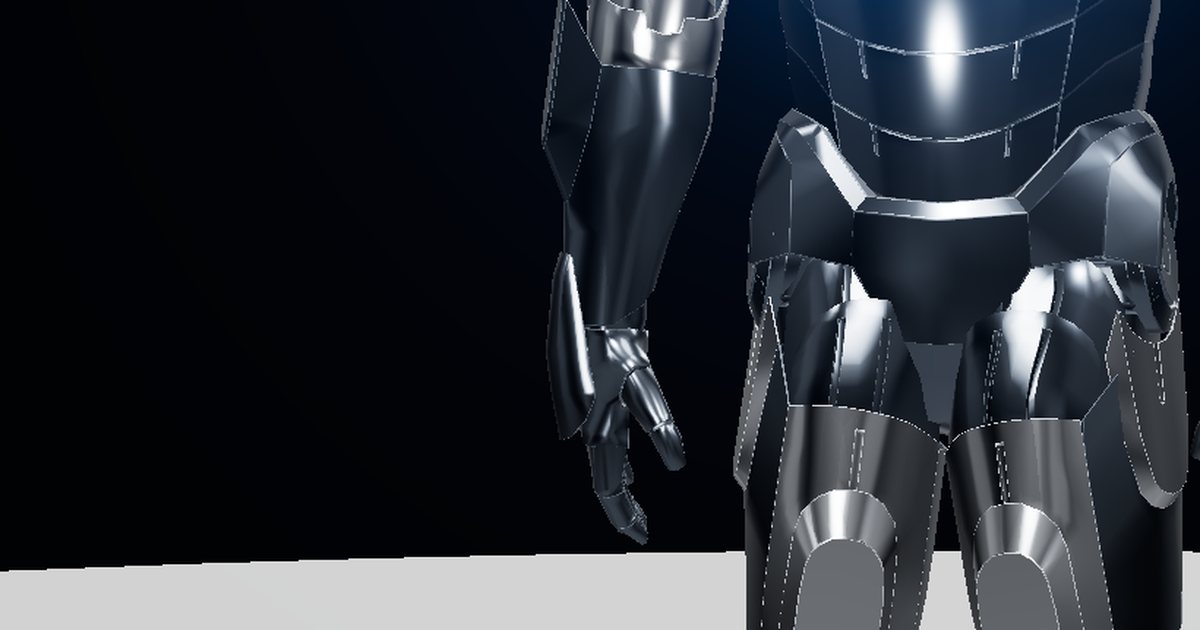
In the films, the palm repulsors do two jobs at once. They help the boot jets balance, steer and brake the suit, and they double as Tony Stark's main weapon: a glowing palm blast that throws people and machines across a room. The chest unibeam is the same idea scaled up, a wide beam fired from the arc reactor, which the films credit with about 3 gigajoules per second (3 gigawatts). The films never say what physically leaves the palm.
So treat the repulsor as what it would have to be in the real world: two machines sharing one aperture. One must make thrust. The other must put energy on a target. They obey different physics, and that difference explains almost everything below. The palms, boots and chest emitter are all labelled in the 3D teardown.
Thrust and energy are different currencies
A thruster works by throwing mass. Thrust is mass flow times exhaust speed (F = ṁ × v), while the power carried by the jet is half the mass flow times the speed squared (P = ½ × ṁ × v²). Divide one by the other and you get the rule that governs every thruster ever built:
Power needed per newton of thrust = v / 2
Throw a lot of mass slowly and thrust is cheap. Throw a little mass very fast and thrust is expensive, though you spend very little propellant. Light is the extreme case. It moves at c, so a beam of light pushes with F = P / c, and each newton of push costs about 300 megawatts. A pure light beam holding up an 890 N suit and wearer would need about 267 gigawatts, close to 90 times the films' reactor.
That 890 N comes from the teardown's light flight model: a 90.7 kg suit plus wearer (90.7 × 9.81), with the two boots carrying about 75 percent of the weight and each palm about 111 N. The full flight budget is in the flight guide.
Why ion and Hall thrusters cannot lift a person
The glowing-plasma look of a repulsor invites a comparison with spacecraft electric propulsion, which really does make thrust from a beam of plasma. The record holder is the X3, a three-channel Hall thruster built at the University of Michigan and fired at NASA Glenn in 2017. NASA's technical record of the tests lists the highest total power (102 kW), thrust (5.4 N) and discharge current ever demonstrated by a Hall thruster, with total efficiency of 0.54 to 0.67 and specific impulse of 1,800 to 2,650 seconds. The test paper adds the details that matter here: the peak 5.4 N came at 99 kW, and the thruster is about 80 cm across and weighs 230 kg.
Run the hover math:
- 890 N ÷ 5.4 N = about 165 X3 thrusters
- 165 × 99 kW = about 16.3 megawatts of electricity
- 165 × 230 kg = about 38 tonnes of thrusters
One X3 weighs about 2,260 N on Earth (230 kg × 9.81) and pushes with 5.4 N, so it could lift roughly one four-hundredth of itself. It also only works in vacuum. The paper's test chamber ran at 4.3 to 42 millionths of a Torr, while sea-level air is 760 Torr, at least 18 million times denser.
Better engineering would not rescue it, because the limit is the v / 2 rule itself. At the X3's exhaust speeds (specific impulse × 9.81, so about 18 to 26 km/s), even a perfect thruster would need 7.9 to 11.6 MW of jet power to hold up 890 N. Electric thrusters suit spacecraft precisely because they throw very little mass very fast, the opposite of what hovering needs.
What about ion wind in air? In 2018 MIT flew the first plane with no moving parts, driven by ionic wind from wires charged to 40,000 volts. It weighed about 5 pounds, needed a 5 meter wingspan, and flew 60 meters across a gym. The ion wind only pushed it forward while the wing did the lifting, and the researchers name thrust density, thrust per unit area, as the problem still to solve. A palm is a very small area.
What a palm thruster would really be
Apply the same rule in the other direction: throw a lot of air slowly. A 10 cm duct in the palm has an exit area of about 0.0079 m². To make 111 N, the air has to leave at about 107 m/s (v = √(F ÷ (ρ × A)), with air at 1.225 kg/m³). That is about 1 kg of air per second and about 6 kW of ideal jet power, roughly 340 times less power than the X3 route to the same thrust. A small fan or turbine can do that. Electric plasma cannot.
This is why the real jet suits that fly today hang small gas turbines on the pilot's arms and back, and why the teardown models the palm's lift as a jet sharing the aperture with a separate weapon. The flight guide covers fuel burn and endurance.
Directed-energy weapons today
There are no plasma-bolt weapons. A blob of plasma in open air cools, recombines and spreads out almost as soon as it leaves the emitter, so it cannot carry energy across a room, let alone a battlefield. The real directed-energy weapons are lasers and high-power microwaves, and several are in service. The Congressional Research Service report on Navy shipboard lasers, updated January 2026, and its companion report on Defense Department directed-energy weapons give the power levels.
| System | Operator | Beam power | Status |
|---|---|---|---|
| LaWS | US Navy | 30 kW | Installed on USS Ponce, August 2014 |
| DE M-SHORAD (Guardian) | US Army | 50 kW | On Stryker vehicles; four prototypes sent to the Middle East in 2024 |
| HELIOS | US Navy, Lockheed Martin | 60 kW class, growth to 150 kW | Delivered 2022, installed on USS Preble |
| Iron Beam | Israel, Rafael | About 100 kW | Delivered to the IDF in December 2025, range up to 10 km |
| IFPC-HEL | US Army, Lockheed Martin | 300 kW class | Prototype |
| BBG(X) battleship lasers | US Navy | 300 or 600 kW each | Proposed December 2025 |
| Unibeam (films) | Fiction | About 1.2 GW from a 3 GW reactor at 40 percent efficiency | See below |
Those figures are measured in the beam, and making the beam costs more. IPG Photonics quotes better than 40 percent energy efficiency for its industrial high-power fiber lasers. Even at 40 percent, a 100 kW beam needs 250 kW of electricity and leaves 150 kW of heat inside the weapon.
The CRS reports are frank about the limits. Lasers only fire along a line of sight, may not work well, or at all, in rain or fog, and suffer thermal blooming, where a beam held on one path heats the air and defocuses itself. Navy lasers are short-range weapons, good out to about a mile and perhaps eventually a few miles. Their strength is cost: Navy estimates put a shot at about $1.15 for a 60 kW laser and $9.20 for a 480 kW one, much of it the fuel to make the electricity.
High-power microwaves are the closest real match to the films' use of the chest beam as an electromagnetic pulse. The Air Force's THOR demonstrator fits in a 20-foot shipping container and engaged a swarm of multiple targets in 2023, and the Army is developing IFPC-HPM to counter drone swarms.
One fact the films ignore: a laser burns, it does not shove. The push of a 100 kW beam is P / c, about 0.00033 N. A repulsor blast that throws a person across a room cannot be a beam of light. It has to be a blast of mass, or a beam that boils material off the target so fast that the target recoils from its own debris.
Storing a shot: capacitors and pulsed power
A weapon in a gauntlet needs a local buffer that charges slowly and discharges fast. That is a capacitor's job, and the best commercial cells set the scale. Maxwell's BCAP3000 ultracapacitor stores 3.0 to 3.3 Wh in 475 g, a specific energy of 6.4 to 6.9 Wh/kg, and can deliver 8.0 to 12.3 kW per kilogram.
Now size one shot from an Iron Beam-class laser held on target for 5 seconds:
- Light delivered: 100 kW × 5 s = 500 kJ
- Electricity at 40 percent efficiency: 1.25 MJ
- Heat left in the gauntlet: 750 kJ
- Ultracapacitor cells at 3.3 Wh (11.9 kJ) each: about 105 cells, or about 50 kg
That is fifty kilograms of capacitors on one arm for one five-second shot, before the laser, the optics and the cooling. The power rating does not help: 250 kW of draw at 12.3 kW/kg needs about 20 kg of cells just to carry the current. For scale, TNT by convention releases 4.184 MJ per kilogram, about 170 times the energy per kilogram of the best ultracapacitor. A palm-sized capacitor cannot hold an explosive-scale blast.
Short pulses make it sharper still. A repulsor shot at the full 3 GW for one millisecond is 3 MJ, or about 121 kg of ultracapacitors. In any real version, the energy for each shot comes from the reactor in real time over the power bus, and the capacitor bank behind each palm only smooths the spike so the bus never sees the full transient. The arc reactor guide covers that bus.
Recoil on the wearer's arm
Newton's third law applies to any repulsor that pushes with mass, whether that is air, exhaust, plasma or projectiles. Whatever momentum leaves the palm, the same momentum comes back into the arm.
Say a blast throws a 90 kg person backward at 5 m/s, a hard shove:
- Momentum given to the target: 90 kg × 5 m/s = 450 N·s
- Momentum back into the shooter: at least 450 N·s, and more, since some of the blast misses
- Delivered over 50 ms: 450 ÷ 0.05 = 9,000 N through one hand, about 918 kilograms-force
- Delivered over 0.2 s: 2,250 N, still about 230 kilograms-force
Unbraced, the teardown's 90.7 kg suit plus wearer would fly backward at about 5 m/s, as fast as the target. Even a 150 kg system would go back at 3 m/s. The films' shooter barely moves, which is only possible if the load runs through the arm frame and spine into the ground, or the boots fire forward to cancel it. That is why the teardown puts maraging-steel recoil mounts behind each palm and ties them into the endoskeleton. See armor and materials and the exoskeleton guide.
In flight it is worse. The two palms carry about a quarter of the hover thrust, so firing one costs thrust and adds a kick, and the flight computer must rebalance within milliseconds. A laser avoids nearly all recoil, since its push is only P / c, but for the same reason it cannot knock anyone over.
The chest unibeam
The unibeam is the one weapon in the films sized to the reactor, so take the films' 3 GW at face value and follow it through:
- Beam ceiling: at the roughly 40 percent efficiency of today's best high-power fiber lasers, 3 GW in gives about 1.2 GW of beam, some 12,000 times Iron Beam
- Heat: about 1.8 GW left inside the chest, 1.8 GJ for every second of firing
- Energy on target: 1.2 GJ per second, about the energy of 287 kg of TNT
- Recoil from the light itself: 1.2 GW ÷ c = 4 N, or 10 N if all 3 GW left as light
The heat is what ends it. 1.8 GJ is enough to boil off about 800 kg of water that is already at its boiling point (at 2.26 MJ per kilogram). Even a perfect radiator near body temperature (300 K) emits only σT⁴ ≈ 460 W per square meter, so no body-sized shell can dump gigawatts in real time. It would have to soak each burst into coolant and phase-change buffers, then stop and wait. That is the argument of our article on heat, and the cooling guide sizes the hardware. A gigawatt beam in air would also bloom far worse than a 100 kW ship laser, heating its own path as it fires.
The recoil, by contrast, is the one part that works out. Even 10 N is about 1.1 percent of the suit's 890 N weight, which the boots can absorb. The unibeam's problem is not that it pushes the wearer. It is that it cooks them.
Fiction against the best real technology
| Capability | In the films | Best real technology today | The gap |
|---|---|---|---|
| Lift from a plasma beam | Hover and steer on palm and boot beams | NASA X3 Hall thruster: 5.4 N at 99 kW, 230 kg, vacuum only | 165 thrusters, 16.3 MW and 38 t to hover 890 N |
| Lift from moving air | Not shown | Ducted fan or turbine jet: 111 N for about 6 kW ideal from a 10 cm duct | Buildable, at the cost of fuel and noise |
| Beam weapon power | Palm blasts and a reactor-fed chest beam | Iron Beam about 100 kW in service; 300 kW class prototypes | A 1.2 GW unibeam is about 12,000 times Iron Beam |
| Energy stored per shot | Instant and unlimited | Ultracapacitor cell: 6.4 to 6.9 Wh/kg, 8.0 to 12.3 kW/kg | About 50 kg of cells per 5 s, 100 kW shot |
| Push from a light beam | Targets thrown across rooms | F = P / c: 0.00033 N per 100 kW | 300 MW of beam per newton of push |
| Recoil | Shooter barely moves | Momentum is conserved | 450 N·s into the arm per 90 kg target thrown at 5 m/s |
The verdict
- Lift from the palms: possible only as a jet that throws air or exhaust, never as an electric plasma beam.
- The palm weapon: real lasers from 30 kW to the 300 kW class exist. A hand-held one is limited by stored energy and heat, not by optics.
- Knockback: only a blast of mass throws a target, and it throws the shooter back just as hard.
- The unibeam: needs the fictional reactor, and even then gigawatts of waste heat end each shot within moments.
The repulsor is two good real ideas, a jet and a laser, fused into one glowing disc. Pulled apart, each is buildable at small scale. At the films' scale, they need a power source and a heat sink that do not exist. The rest of the suit is laid out subsystem by subsystem in the engineering guides, and the sensors that would aim these weapons are in the HUD and sensors guide.
FAQ
Could an ion thruster ever lift a person?
Not on Earth. The record Hall thruster, NASA's X3, makes 5.4 N from 99 kW and weighs 230 kg, so it cannot lift itself, and it only runs in vacuum. Hovering an 890 N suit and wearer would take about 165 of them and 16.3 MW.
How powerful are real laser weapons?
Fielded systems run from about 30 kW (the Navy's LaWS, 2014) to about 100 kW (Israel's Iron Beam, delivered in December 2025), with 300 kW class prototypes in development. They work out to roughly a mile to a few miles, in clear air.
Would firing a repulsor knock Iron Man backward?
Yes, if it pushes the target with mass. Throwing a 90 kg person back at 5 m/s puts at least 450 N·s into the shooter's arm, about 9,000 N if it happens in 50 ms. A laser has almost no recoil, but cannot shove anyone.
Could a capacitor store a repulsor blast?
Only a small one. The best commercial ultracapacitor cells hold about 6.9 Wh/kg, so a single 5 second shot from a 100 kW laser needs about 50 kg of them. TNT holds about 170 times more energy per kilogram.
Is the unibeam possible?
The beam physics is real, but the power and heat are not. Even granting a 3 GW reactor, the beam tops out near 1.2 GW and leaves about 1.8 GW of heat in the chest for every second it fires.