Could the Iron Man arc reactor be real?
Updated 2026-11-23 · 13 min read
Short answer
Not as shown. In the films it makes 3 gigawatts from a chest puck, millions of times the power density of ITER, the largest fusion machine being built. The suit itself needs only a few megawatts, and the best real source for that today is a kerosene jet engine, not a reactor.
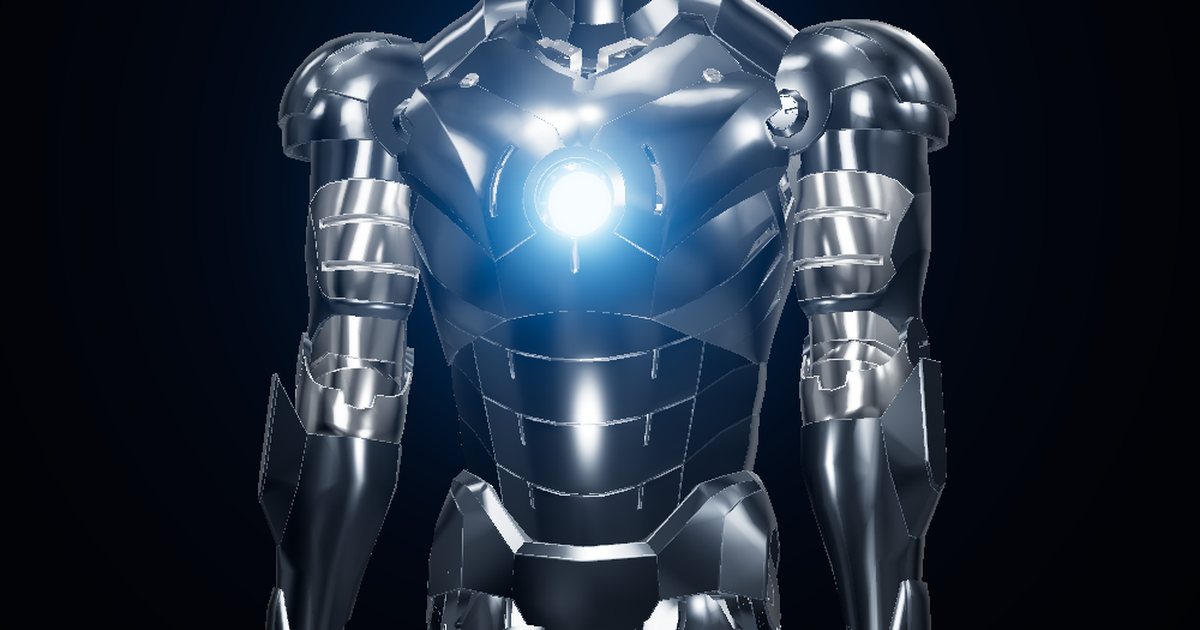
What the films actually claim
In the films, Tony Stark gives the number himself: the reactor in his chest produces three gigajoules of energy per second. Los Alamos National Laboratory's review of fusion in the movies quotes the line and adds the blunt real-world note that an output like that would likely require a building-sized reactor.
A gigajoule per second is a gigawatt, so the arc reactor is a 3 GW power plant. In horsepower, 3,000,000,000 W ÷ 745.7 W per hp ≈ 4 million hp. Two comparisons put that in perspective:
- A nuclear power station. Westinghouse says one AP1000 reactor supplies over 1 GW of electricity to the grid. The arc reactor claims roughly three times that from a device that sits in a socket in a man's sternum.
- A fuel tanker. Jet fuel is specified at a minimum of 42.8 MJ of energy per kilogram. Matching 3 GW by burning it takes 3,000 MJ/s ÷ 42.8 MJ/kg ≈ 70 kg of fuel every second, about 4.2 tonnes a minute, before counting a single engine loss.
So "could it be real?" is really three questions. Is there any fuel with enough energy? Could anything release that energy fast enough, in that volume? And does the suit even need 3 GW? The answers are yes, no, and no.
The fuel is the one part the fiction gets right
Chemistry cannot do this. Nuclear physics can, at least on paper. Fusing deuterium with tritium, the reaction nearly every serious fusion machine is built around, releases 17.6 MeV per reaction. Run the arithmetic:
- 17.6 MeV is 2.82 × 10⁻¹² joules.
- One deuterium nucleus plus one tritium nucleus weighs about 5.03 atomic mass units, or 8.35 × 10⁻²⁷ kg.
- So D-T fuel holds about 3.4 × 10¹⁴ J per kilogram, roughly 8 million times the energy of the same mass of jet fuel.
At that density, running the arc reactor flat out for a full hour (3 × 10⁹ W × 3,600 s = 1.08 × 10¹³ J) consumes about 32 grams of fuel. A chest puck could plausibly carry a day's supply. Energy conservation is not where the arc reactor breaks.
There is a catch hiding in that same reaction. The HyperPhysics reference notes that 80% of the energy leaves with the neutron. Neutrons carry no electric charge, so no magnetic field can steer them, and a 3 GW D-T source would fire roughly 2.4 GW of fast neutrons out through the wearer's chest. Real fusion machines surround themselves with thick shielding for exactly this reason, and so would any arc reactor that burned D-T.
Where it breaks: power density
The problem is not how much energy fusion fuel holds. It is how fast you can release it, and in how small a space. Here is the best real fusion has done.
ITER, the international tokamak under construction in France, is designed to produce 500 MW of fusion power from 50 MW of input heating, a tenfold return. The machine will weigh 23,000 tonnes and hold a plasma of 830 cubic metres. That works out to:
- 500 MW ÷ 830 m³ ≈ 0.6 MW per cubic metre of plasma.
- 500 MW ÷ 23,000,000 kg ≈ 22 W per kilogram of machine, and that is heat, not electricity.
Now give the arc reactor a generous full litre of volume, a cube 10 cm on a side, which is larger than anything the films show. 3 GW in 0.001 m³ is 3 × 10¹² W per cubic metre, about 5 million times ITER's plasma power density.
The National Ignition Facility at Lawrence Livermore takes the other route, crushing a tiny fuel capsule with lasers. In December 2022 it produced 3.15 MJ of fusion energy from 2.05 MJ of laser energy, the first time a fusion experiment released more energy than was delivered to its target. Its record shot, in April 2025, yielded 8.6 MJ at a target gain of 4.13. Those are historic results. They are also single shots. The fictional reactor produces 8.6 MJ every 2.9 milliseconds (8.6 × 10⁶ J ÷ 3 × 10⁹ W), continuously, all day.
The reason size matters is physical, not just a backlog of engineering. Fusion needs a plasma hot enough and confined long enough for nuclei to collide and fuse, and a smaller plasma loses its heat faster. That is why the machines that work keep getting bigger, and why the Los Alamos verdict of building-sized is the honest one.
Fission does not rescue the idea either. It is the mature way to make gigawatts, but it does so at the scale of the AP1000 above: a power station, not a pendant.
The palladium story
In the films the arc reactor's core is palladium, and the second film turns that choice into a plot: the core slowly poisons Tony's blood until he synthesizes a new element to replace it.
The choice of metal was not random. In early 1989, chemists Martin Fleischmann and Stanley Pons at the University of Utah claimed they had induced fusion by passing a current through a simple electrochemical cell, with palladium as the metal packed with heavy hydrogen. Los Alamos notes palladium was a notable component of that cold-fusion research. Laboratory after laboratory failed to reproduce the effect. Thirty years later, a multi-institution program revisited cold fusion to a modern standard of rigor, and its 2019 report in Nature had yet to find any evidence of it. Los Alamos also mentions a later Canadian result in which palladium modestly boosted fusion rates in a small experimental reactor: a rate boost, not a power source.
The poisoning is fiction too. The World Health Organization's review of palladium and human health records that palladium alloys are widely used in dentistry for crowns and bridges, that palladium chloride given by mouth was poorly absorbed (under 0.5% of the dose in adult rats), and that most human case reports concern sensitivity to palladium in dental work. A real palladium hazard looks like an allergy, not a creeping blood toxicity. And palladium is not a fusion fuel at all, so a working reactor would have no reason to use it up.
What the suit actually needs
Here is the twist. Even if we grant the miracle, 3 GW is far more than flight requires. Take a 150 kg system: a wearer plus a light suit. (The armor guide explains why real protection would weigh more.)
Hovering means pushing down 150 kg × 9.81 m/s² ≈ 1,470 N of thrust. The power in a jet is half the thrust times the exhaust speed. A real microturbine like the JetCat P400-PRO exhausts at 2,122 km/h (589 m/s), so a jet hover at that exhaust speed needs 0.5 × 1,470 N × 589 m/s ≈ 434 kW of jet power. That is the physics floor.
A real engine burns a lot more than that. JetCat lists a specific fuel consumption of 0.157 kg per newton per hour at full thrust, so holding up 1,470 N burns about 231 kg of fuel an hour. At 42.8 MJ/kg that is 2.7 MW of chemical power, of which only about 16% ends up as jet power.
Fast flight is set by drag. The flight guide works it through: pushing a streamlined body through sea-level air at the speed of sound takes roughly 8,900 N of thrust and 3 MW of thrust power, and a less streamlined body needs several times more.
Everything else on the suit, from the exoskeleton's actuators to the HUD and sensors and life support, draws far less than propulsion.
So a real suit's power budget is single-digit megawatts, roughly a thousandth of the films' figure. The arc reactor's 3 GW is not a requirement. It is a margin of about a thousand to one. A reactor that delivered "only" 3 MW from a few kilograms would still be one of the most remarkable machines ever built.
Real power sources, compared
The first table compares sources by the power they deliver and what they weigh to do it.
| Power source | Output | Mass or scale | Output per kg | Status today |
|---|---|---|---|---|
| Arc reactor (in the films) | 3 GW | A chest puck | Not given | Fiction |
| ITER tokamak (fusion) | 500 MW of heat from 50 MW of heating | 23,000 t | About 22 W/kg (heat) | Under construction |
| National Ignition Facility (laser fusion) | 8.6 MJ per shot, gain 4.13 | A laboratory complex | Pulsed, not continuous | Record shot April 2025 |
| AP1000 (fission) | Over 1 GW of electricity | A power station | Not comparable | Operating |
| NASA Kilopower (fission) | 10 kW of electricity | About 1,500 kg | About 7 W/kg | 1 kW-class ground test, 2018 |
| MMRTG (plutonium-238 decay) | 110 W of electricity, about 2,000 W of heat | 45 kg | About 2.4 W/kg | Powering Curiosity and Perseverance |
| JetCat P400-PRO (microturbine) | 116.4 kW of jet power, 425 N | 4.01 kg, plus fuel | About 29 kW/kg | Commercial |
| SkelCap supercapacitor | Short, high-current pulses | A single cell | 28 to 36 kW/kg | Commercial |
The second compares stores by the energy they carry. The last column asks how long one kilogram of each could keep the 150 kg system hovering at the 434 kW jet-power floor, if every joule became jet power.
| Energy store | Energy per kg | Hover time per kg, no losses |
|---|---|---|
| SkelCap supercapacitor | 8.27 to 11.1 Wh (0.03 to 0.04 MJ) | About 0.07 to 0.09 s |
| Best lithium cell (Amprius SiCore 500) | 500 Wh (1.8 MJ) | About 4 s |
| Jet fuel | 42.8 MJ | About 99 s (a real JetCat-class turbine gets about 16 s) |
| D-T fusion fuel (theoretical) | 3.4 × 10⁸ MJ | About 25 years |
Read the two tables together and the shape of the problem is plain. The sources with enough output per kilogram (turbines, capacitors) carry little energy, and the sources with enormous energy (fusion, fission, plutonium) deliver it at a few watts per kilogram of machine.
Batteries and capacitors: the realistic backups
Batteries. Amprius rates its new SiCore 500 cell at 500 Wh/kg, measured at a 1C continuous discharge, with commercial availability expected in late 2026. That is about as good as rechargeable cells get. Yet one hour of hover at 434 kW is 1.56 GJ, which is about 870 kg of those cells, more than five times the mass they are meant to lift. A 10 kg emergency pack stores 18 MJ, enough for about 41 seconds. The 1C rating also assumes the cell drains over an hour; emptying it in minutes asks far more of it.
Capacitors. Skeleton Technologies lists its SkelCap cells at 28.4 to 36.5 kW of power but only 8.27 to 11.1 Wh of energy per kilogram. A 10 kg bank holds about 300 kJ (10 × 8.27 Wh × 3,600 s per hour) and can release it in about a second at 300 kW. That makes capacitors the right tool for a weapon pulse (see the repulsors guide) and the wrong tool for staying in the air.
RTGs and small reactors: real nuclear power, tiny output
The nuclear sources that actually fly are built for endurance, not muscle. NASA's MMRTG, the generator powering the Curiosity and Perseverance rovers, carries 4.8 kg of plutonium dioxide that gives off about 2,000 W of heat. It turns that into about 110 W of electricity at launch, from a unit weighing 45 kg, and is rated for a 17-year design life. To make the suit's 434 kW you would need about 3,900 of them: 177 tonnes.
NASA's Kilopower fission design, built around a uranium-235 core about the size of a paper towel roll, produces 1 to 10 kW of electricity for 10 years or more, and weighs about 400 kg at 1 kW or 1,500 kg at 10 kW. Its ground test in March 2018 was a real milestone for space power. Matching the suit's hover would take 43 of the 10 kW units, about 65 tonnes, and a reactor worn on a body would also need shielding against its own radiation.
And then there is the heat
Every watt the suit uses ends up as heat. A turbine at least blows most of its waste heat out of the nozzle. A reactor core does not: whatever share of its output is lost in conversion stays inside the shell, and at 3 GW even a 3% loss is 90 MW, a power-station-sized space heater strapped to a person. Our article on the suit's real enemy runs the radiator math, and the cooling guide covers the hardware that fights it. Of all the reasons the arc reactor cannot work, this is the one no future breakthrough in fusion would fix.
The verdict
- Energy: plausible. Fusion fuel holds enough energy that 32 grams would run the fictional reactor for an hour.
- Power density: not possible with any known approach. The arc reactor is about 5 million times denser than ITER's plasma, and the best real fusion results are single laser shots in a laboratory complex.
- The palladium: a nod to the failed 1989 cold-fusion claims, and its toxicity is dramatized.
- What the suit needs: megawatts, not gigawatts. Today the best real way to supply that is the one every real jet suit uses: a kerosene microturbine and a fuel tank, which is why those suits fly for minutes rather than hours.
The arc reactor is the one invention every other part of the suit leans on. Strip it out and the 3D teardown still holds together as a machine, but it becomes a machine that flies for a few minutes on jet fuel. The other subsystems are mapped in the engineering guides.
FAQ
How much power does the arc reactor produce?
In the films, 3 gigajoules per second, which is 3 GW or about 4 million horsepower. That is roughly three times the electricity one AP1000 nuclear reactor supplies to the grid.
Why does the arc reactor use palladium?
It nods to the 1989 Fleischmann and Pons cold-fusion claim, in which palladium soaked up heavy hydrogen in a bench-top cell. The claim was never reproduced, and a rigorous 2019 re-examination found no evidence for it.
Could a battery power an Iron Man suit?
Not for long. The best cells store about 500 Wh/kg, so a 10 kg pack would keep a 150 kg suit hovering for well under a minute, and an hour would take about 870 kg of cells.
Is compact fusion close to an arc reactor?
No. ITER, the flagship fusion machine, is designed for 500 MW of heat and will weigh 23,000 tonnes. Los Alamos estimates that the arc reactor's output would likely need a building-sized reactor.
What is the closest real thing to an arc reactor?
By output per kilogram, a jet engine: a 4 kg JetCat microturbine delivers about 116 kW of jet power. By being a compact nuclear source, NASA's MMRTG, which makes about 110 W from 45 kg.
Does the suit really need 3 gigawatts?
No. Hovering a 150 kg system takes about 434 kW of jet power, and flying at the speed of sound at sea level takes about 3 MW. The fictional figure is roughly a thousand times what flight requires.