How does the Iron Man suit work?
Updated 2026-11-23 · 11 min read
Short answer
As a powered exoskeleton in layers: a sensor undersuit reads the wearer, a titanium frame and joint motors move with them, armor plates sit on top, and one power source feeds everything. In flight the boots give about three quarters of the lift and the palms steer, while a helmet display, oxygen supply and cooling garment keep the pilot informed, breathing and alive. Every piece has a real counterpart today; what no real machine has is the power, the heat rejection and the g-tolerance to run them all at once.
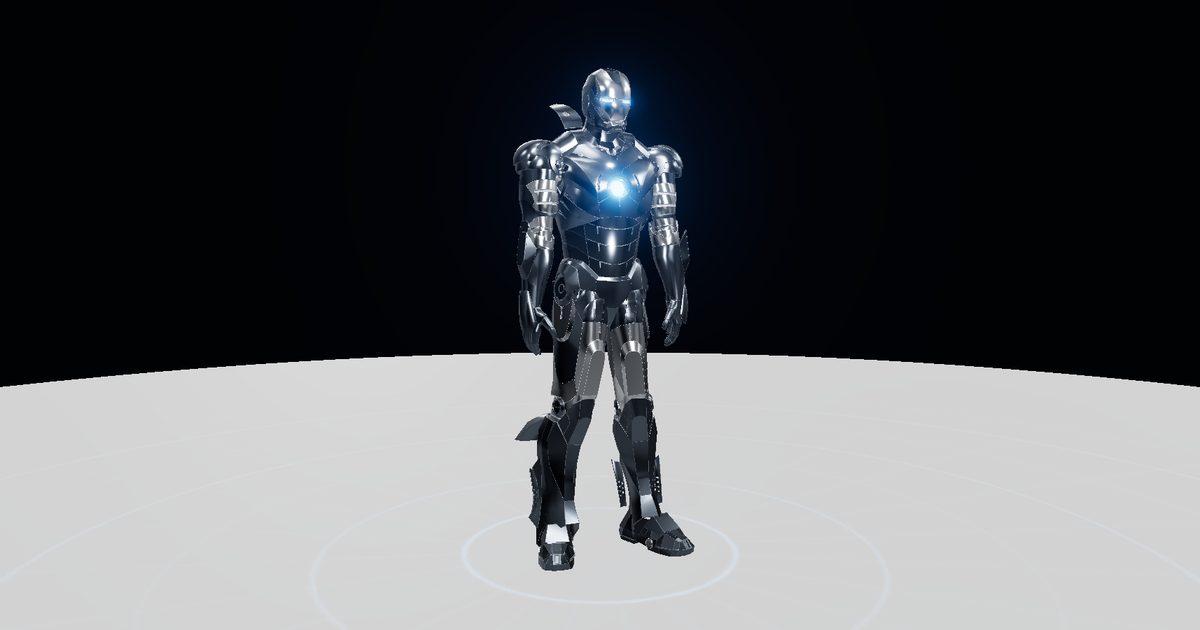
The suit in one paragraph
Treat the Iron Man suit as a real machine and it is a powered exoskeleton built in layers, like an onion around a person. Against the skin sits a sealed sensor undersuit that reads the wearer's muscles and carries a liquid cooling loop. Over it runs a load-bearing endoskeleton of titanium, with a motor at every joint that moves in step with the wearer. On top of the frame sits impact padding, and outermost the armor plates, latched to the frame. One power source in the chest feeds a power bus that runs to every motor, thruster, sensor and pump. The helmet holds the display, the cameras and the microphones, and the back holds the computer, the radios and the life-support pack. You can see every one of these layers, and all 81 parts, in the interactive 3D teardown and on the parts page.
The rest of this page follows that machine one system at a time: what it does in the films, the real technology that comes closest, and the limit that stops it. Each section links to the guide that works the numbers.
Power: one source for everything
In the films the suit runs on the arc reactor, a glowing puck in the chest that makes about 3 gigawatts. That is the reason the suit can do everything at once: it never runs out. The arc reactor guide shows that 3 GW from a chest-sized device is millions of times the power density of ITER, the largest fusion machine being built.
A real suit needs far less than that, but still a lot, and the needs differ by job. Walking in a full-body exoskeleton such as the Sarcos Guardian XO takes about 500 W, which a battery supplies for about two hours per kilowatt-hour (see the exoskeleton guide). Flying takes hundreds of kilowatts: Gravity Industries' jet suit is quoted at 1,050 to 1,500 bhp, roughly 780 kW or more, and gets it the only way anything body-worn can today, by burning kerosene in small gas turbines. So a real suit would carry two power sources, batteries for the frame and the electronics and jet fuel for flight, and the gap between them is a factor of more than a thousand.
Moving with the wearer: frame, motors and intent
The suit has to move when the wearer moves, without them feeling its weight. A real exoskeleton does this with sensors that read the wearer and an electric motor at each joint that drives the limb in parallel. There are two ways to read intent:
- Force sensors at the hands and feet feel which way the wearer pushes, and the motors follow. This is how the Guardian XO works.
- Electromyography (EMG) electrodes on the skin pick up the electrical signal of a muscle, which arrives before the limb visibly moves, so the suit can start moving first.
The best documented full-body example, the Guardian XO, weighs 68 kg, lets its wearer lift 90 kg as if it were 4.5 kg, and draws about 500 W. The joints use small, fast motors behind high-ratio strain-wave gears, the same choice modern humanoid robots make. The exoskeleton guide covers latency, torque and why the films' instant, all-day motion is still out of reach.
Armor: what stops a hit
The films call it a gold-titanium alloy. A real suit would split that into separate jobs done by separate materials, as the armor guide explains:
- Structure: titanium alloy Ti-6Al-4V, about half the density of steel, for the frame and the shell.
- Stopping rifle rounds: ceramic strike plates of boron carbide or silicon carbide, backed by polyethylene or aramid fiber that catches the fragments.
- The gold: only a film about 100 nanometers thick that reflects infrared heat, as on astronaut visors.
The cost is weight. Rifle-rated plate weighs about 41 to 45 kg per square meter, and covering a person's whole body takes about 2.4 square meters, so the armor alone comes to roughly 100 kg. Add a frame strong enough to carry it and the suit is near 170 to 200 kg before anything else; the weight guide builds the full mass budget.
Flight: boots for lift, palms for steering
The suit flies the way real jet suits do: by pushing exhaust downward hard enough to cancel its own weight, 9.81 newtons for every kilogram. In this teardown's layout the boot thrusters carry about 75% of the lift and the palm thrusters about 25%. The palms matter more than their share suggests, because they sit at the end of long arms: a small push there turns the whole body, which is how the suit steers and balances. Small attitude thrusters on the back and flaps help hold it steady.
This part is real. Richard Browning's Gravity jet suit flies on five small turbines, two on each arm and one on the back, weighs 27 kg dry and holds the Guinness record at 85.06 mph. Its pilot steers by moving his arms, exactly the job the films give the palms. The limit is fuel: the turbines burn about 4 litres of jet fuel a minute, so real flights last minutes. The flight guide works out the hover math and why an hour aloft would need a suit that is mostly fuel, and the real Iron Man suits page lists every jet suit and jetpack flying today.
Repulsors and weapons
On screen the repulsors in the palms both lift the suit and fire as weapons. Real physics splits them into two different machines, as the repulsors guide shows:
- For lift, a beam of charged particles is far too weak. NASA's record X3 plasma thruster makes 5.4 newtons from 99 kilowatts, so hovering on such beams would take about 165 of them and 16 megawatts. Lift has to come from a jet that throws air or exhaust.
- As a weapon, the closest real device is a laser. Today's laser weapons run at 30 to 300 kilowatts and are limited by stored energy, heat and recoil, which is why they sit on trucks and ships rather than on a wrist.
A real suit would carry a capacitor bank to deliver short bursts, the job the teardown gives each gauntlet.
Seeing and thinking: HUD, sensors and computer
Inside the helmet the films show a display that wraps around the wearer's view, fed by sensors that see in every direction, with an assistant that talks back. Most of that already exists in pieces, as the HUD and sensors guide details:
- The display: the F-35 fighter's helmet projects a 30 by 40 degree image onto the visor, fed by six sensors spread around the jet, so the pilot can look through the floor of the cockpit.
- Keeping it in sync: mixed-reality headsets redraw the world within about 12 milliseconds of a head turn, the delay below which the picture feels attached to the world.
- The sensors: thermal cameras the size of a thumb run on about 150 milliwatts, and radar, LIDAR and satellite navigation all come in small packages.
- Control: voice is the main way to talk to the suit, because hands are busy in flight. Brain interfaces are real but slow: the best implanted ones decode about 62 words per minute.
The computer that fuses all of this sits in the back, and its heat is one more load on the cooling system.
Breathing and staying cool
A sealed suit has to keep its wearer alive inside it. The life-support part is a solved problem: a NASA spacesuit supplies oxygen, scrubs carbon dioxide and holds pressure for about seven hours, and the life support guide shows how a suit would do the same with an oxygen generator and a scrubber in the back.
Cooling is harder. A person at work makes a few hundred watts of heat, and a liquid cooling garment, a suit of thin tubes carrying chilled water against the skin, carries it away, as in a spacesuit. The machine's own waste heat is another matter: motors, computers and above all the engines make far more heat than any surface a body can carry can shed. The cooling guide treats this as the suit's hardest real constraint, and heat, not power, is the suit's real enemy explains why.
How the systems fit together
| System | What it does in the films | Closest real technology | What limits it | Guide |
|---|---|---|---|---|
| Power | 3 GW arc reactor in the chest | Batteries for walking, kerosene turbines for flight | Power density | Arc reactor |
| Motion | Moves with the wearer, adds strength | Sarcos Guardian XO exoskeleton, EMG sensing | Weight, latency, battery life | Exoskeleton |
| Armor | Shrugs off rifle fire and crashes | Titanium frame, ceramic strike plates, aramid backing | About 100 kg for full coverage | Armor and materials |
| Flight | Hours of supersonic flight | Gravity jet suit: 5 turbines, 85.06 mph record | Fuel burn: minutes, not hours | Flight |
| Repulsors | Lift and a weapon in each palm | Jet thrust for lift, lasers for the weapon | Thrust per watt, stored energy | Repulsors |
| HUD and sensors | Wraparound display, sees everything | F-35 helmet display, thermal cameras, radar | Latency, field of view, compute heat | HUD and sensors |
| Life support | Air and pressure anywhere | NASA spacesuit: about 7 hours | G-forces on the human | Life support |
| Cooling | Never mentioned | Liquid cooling garment, radiators | Waste heat from the machine | Cooling |
Why it only works on screen
Each system above has a real counterpart, and several are flying or on sale today. The suit fails as a whole, at three walls the engineering verdict sets out:
- Power. Nothing you can wear supplies hundreds of kilowatts for hours. The arc reactor is the one invented part the rest depends on.
- Heat. Every watt the suit uses ends up as heat inside a sealed shell, and a body-sized shell cannot shed it fast enough.
- The human. People black out at about 4 to 5 g without protection and fighter pilots in g-suits hold about 9 g, according to the FAA. The turns and landings in the films imply tens to hundreds of g, and no machine cancels inertia.
The verdict
- How it works: a powered exoskeleton with armor on top, jets in the boots and palms, a fighter-style helmet display and spacesuit life support, all fed from one power source.
- What is real: every one of those systems, separately: jet suits fly, exoskeletons add strength, fighter helmets show a HUD, spacesuits keep people alive.
- What is not: the power source, the cooling to match it and a body that survives the maneuvers. Put the real pieces together and you get a heavy machine that walks for hours or flies for minutes, not both.
See how the layers fit in the 3D teardown, read what a real one would cost, or go part by part.
FAQ
How does the Iron Man suit fly?
By pushing exhaust downward with enough force to cancel its weight, 9.81 newtons per kilogram. In this teardown the boot thrusters give about 75% of the lift and the palm thrusters steer from the end of the arms. Real jet suits fly the same way on small kerosene turbines, for a few minutes at a time.
How does the Iron Man suit get its power?
In the films, from the arc reactor in the chest, said to make about 3 gigawatts. A real suit would need two sources: batteries for the frame and electronics, which use hundreds of watts, and jet fuel for flight, which needs hundreds of kilowatts.
How does Tony Stark control the suit?
The suit reads his body and his voice. A real version would use force sensors and EMG electrodes, which pick up a muscle's electrical signal before the limb moves, so the joint motors can move with him, plus a voice assistant for everything his hands cannot reach in flight.
How does the Iron Man helmet display work?
Like a fighter pilot's helmet. The F-35's display projects a 30 by 40 degree image onto the visor, fed by six sensors around the aircraft, and the picture has to redraw within about 12 milliseconds of a head turn to feel fixed to the world.
What is inside the Iron Man suit?
From the skin out: a sensor undersuit with a liquid cooling loop, a titanium frame with a motor at each joint, impact padding and armor plates. The chest holds the power source, the back the computer, radios and life support, and the boots and palms the thrusters. The parts page lists all 81 parts.
Could the Iron Man suit work in real life?
Its parts already do, separately. Together they fail on power, heat and the g-forces a human can survive, which is why a real suit could either walk for hours or fly for minutes, but not fight like the films. The engineering verdict goes system by system.