How much does the Iron Man suit weigh?
Updated 2026-11-23 · 14 min read
Short answer
In the comics, Marvel lists Iron Man at 425 lb (193 kg) in armor and 225 lb without it, while the films give no official weight for the Mark III or later suits. The real Mark I costume from the 2008 film weighed about 90 lb (41 kg). A real, rifle-proof suit would weigh about 190 to 220 kg empty, 270 to 300 kg with its wearer, and about 360 kg fueled to fly.
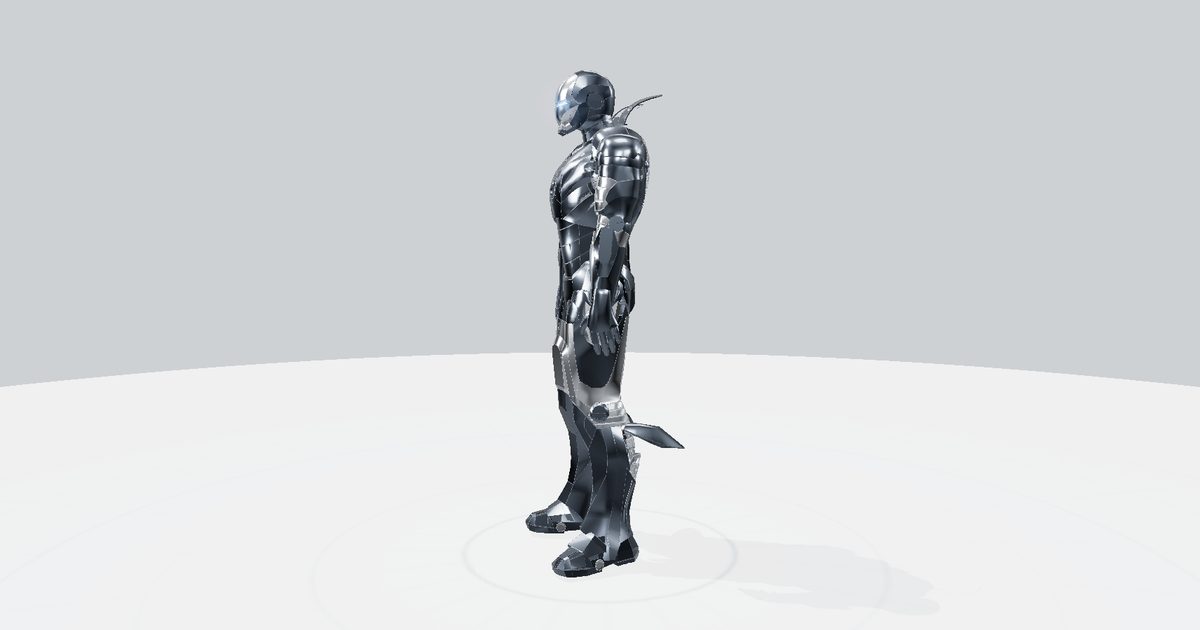
Three answers to one question
The question has three different answers, and most confusion online comes from mixing them up:
- Comics and films (fiction): Marvel puts comic-book Iron Man at 425 lb (193 kg) in armor, 200 lb more than Tony Stark alone. The films give no official weight for the Mark III or Mark 85.
- The costumes (props): the practical 2008 Mark I weighed about 90 lb (41 kg). Most later suits were partial costumes finished in computer graphics.
- A real suit (engineering): rifle-rated armor, a powered frame and life support come to about 190 to 220 kg empty, and about 360 kg at takeoff with engines, fuel and its wearer.
Every plate and system below can be explored in the 3D teardown and in the list of every part by body area.
What the comics and films say (fiction)
These are story figures, not engineering, and they disagree with each other:
| Suit | Where the figure comes from | Stated weight | In kg |
|---|---|---|---|
| Comic-book Iron Man, in armor | Marvel.com profile | 425 lb in armor, 225 lb without; 6 ft 6 in in armor, 6 ft 1 in without | 193 and 102, so the armor is about 91 |
| Comic Mark V armor | Marvel technical data, reproduced by the fan site Marvel Directory | 215 lb, 75 in tall | 98 |
| Comic Mark VI and Mark VII | Same | 240 lb each, 78 in tall | 109 |
| Comic Bleeding Edge armor (2010) | The Invincible Iron Man, per Wikipedia | Adds under 25 lb to Stark | Under 11 |
| Film Mark I, fully loaded | Marvel's 2013 JARVIS app, quoted with a screenshot | 1,500 lb | 680 |
| Film suit as designed | Shane Mahan, the suits' builder, in WIRED | 600 to 800 lb, 6 ft 5 in tall | 272 to 363 |
| Film Mark III, Mark 85 | No official figure found | None | None |
Marvel's 91 kg is close to what real rifle plate over a whole body weighs, except that the comic armor shrugs off tank shells. The comic Mark V is a steel-alloy suit, not the suitcase armor of Iron Man 2. The Bleeding Edge armor lives inside Stark's body as nanoparticles and stops a howitzer shell, which is fiction ignoring mass entirely. The films' fan wiki lists no weight for the nanotech Mark 85, or for the Mark III.
The WIRED 2010 figures, read carefully
The article most answers lean on is Secrets of Iron Man's New Suits, an io9 interview with Shane Mahan that WIRED republished on 7 May 2010. It contains two numbers, and neither is what a costume weighed:
- 600 to 800 lb (272 to 363 kg). Mahan calls this "the number that we kicked around with the design team" for a suit 6 ft 5 in tall: how heavy the suit is meant to be in the story. In the same answer he says the real suit is "quite light" and "has to feel like it's being made out of metal."
- 215 lb (98 kg). This is the comic-book Mark V from Marvel Directory, added by the writer after the interview. It is not the film's Mark V.
An answer that gives either figure as the suit's weight "according to WIRED" is quoting fiction as if it were a prop.
What the film costumes weighed (real props)
| Suit | Film | Built by | Weight | How it was used |
|---|---|---|---|---|
| Mark I | Iron Man (2008) | Stan Winston Studio | About 90 lb (41 kg) | Practical; could be worn as a top half only |
| Iron Monger | Iron Man (2008) | Stan Winston Studio | About 800 lb (363 kg), 10 ft tall | Animatronic on a gimbal, up to five operators |
| Mark III | Iron Man (2008) | Stan Winston Studio, with ILM | Not published | Often only chest, helmet and arms over a motion-capture suit |
| Iron Man 2 suits | Iron Man 2 (2010) | Legacy Effects, ILM, Double Negative | "Quite light", not published | Torso-up "football suits"; computer graphics for most shots |
| Mark XLII, Iron Patriot | Iron Man 3 (2013) | Legacy Effects, several effects studios | Not published | Partial suits and soft suits, mostly replaced digitally |
| Ironheart Mk 1 | Black Panther: Wakanda Forever (2022) | Legacy Effects | 52.5 lb (24 kg), with one piece off | Entirely practical |
The 2008 figures come from the film's production notes: Mahan said the Mark I "ended up weighing about 90 pounds because we had to make the internal structure sound enough so that it could withstand some hits." The Mark III was cast in lightweight epoxies and urethanes over metal substructures, and Robert Downey Jr. often wore only its chest, helmet and arms over a motion-capture suit.
For the sequel, Legacy Effects made the suits lighter and quicker to put on, and ILM's Ben Snow described torso-up "football suits" with computer graphics for the rest. On Iron Man 3, partial suits served as lighting and movement reference. Ironheart's fully practical suit, aluminum and thin urethane castings, weighed 52.5 lb according to the actor who wore it.
So the practical suits weighed 24 to 41 kg, about as much as a medieval knight's armor, and most of what you see on screen weighs nothing.
What a real suit would weigh: the mass budget
Now build one for a 180 cm, 80 kg wearer: it stops rifle fire everywhere, walks under its own power, and is sealed for four hours. Each line is sized from real hardware:
| System | Real hardware it is sized from | Arithmetic | Mass |
|---|---|---|---|
| Armor | RF3 rifle plate (Point Blank LV 7200) | 2.4 m² × 41 to 45 kg/m² | 98 to 108 kg |
| Frame and actuators | Sarcos Guardian XO exoskeleton | As built, rated for a 90 kg load | 68 kg (a floor) |
| Power for the frame | 1 kWh: two hours at the XO's 500 W | 1,000 Wh ÷ 92 Wh/kg, or ÷ 500 Wh/kg | 2 to 11 kg |
| Life support | Dräger PSS BG 4 plus closed-circuit rebreather | As sold, ready for use, 4 hours | 15.5 kg |
| Cooling | NASA liquid cooling garment plus a spacesuit's thermal loop | 2.95 + 2.95 kg | 5.9 kg |
| Avionics and HUD | F-35 helmet, a LIDAR, a spacesuit's avionics | 2.1 to 2.3 + 0.3 + up to 6.8 kg | 2.4 to 9.4 kg |
| The suit, empty | Sum of the lines | 192 to 218 kg | |
| With its wearer | + 80 kg | 272 to 298 kg |
Armor. The Mosteller formula gives a 180 cm, 80 kg person √(180 × 80 ÷ 3,600) = 2.0 m² of skin; plates sit off the body, so add 20% to get 2.4 m². Point Blank's LV 7200, a 10 by 12 inch plate rated against armor-piercing rifle rounds, weighs 7.0 to 7.7 lb (3.2 to 3.5 kg) over 0.0774 m², or 41 to 45 kg/m². Half the suit is armor; the armor guide explains why.
Frame and actuators. The Sarcos Guardian XO weighs 150 lb (68 kg) and lets its wearer lift 90 kg. This frame must carry 125 to 150 kg of armor and systems, so 68 kg is a floor. See the exoskeleton guide.
Power. The XO runs about two hours on two 12 lb, 500 Wh packs: 1,000 Wh ÷ 10.9 kg = 92 Wh/kg. Amprius rates its best cells at 500 Wh/kg, or 2 kg for the same 1 kWh before casing. In the films the arc reactor replaces this line and the fuel below.
Life support. A suit sealed against smoke, water or thin air needs a closed-circuit rebreather. Dräger's BG 4 plus weighs 15.5 kg ready for use for four hours, including mask, oxygen cylinder, CO2 absorber and 1.2 kg of cooling ice. NASA's spacesuit backpack agrees: its oxygen loop alone has 33.6 lb (15.2 kg) of components, per a 2026 NASA study of suit masses. See the life support guide.
Cooling. The same study lists the liquid cooling garment at 6.5 lb (2.95 kg) wet, and the backpack's thermal loop at another 6.5 lb. That cools the wearer only; the machine's own heat is the harder problem, as the cooling guide shows.
Avionics and HUD. The F-35's helmet display dropped from 5.1 to 4.6 lb (2.3 to 2.1 kg) in 2017, and a Livox Mid-360 LIDAR adds 265 g. The backpack's avionics, 15 lb (6.8 kg), set the upper end. See the HUD and sensors guide.
Read these as floors: in NASA's backpack, structure, covers, tubing and harnesses outweigh the components they hold, 75.8 lb against 65.2 lb. Armor plus frame alone come to 166 to 176 kg, which is where the engineering hub gets its 170 to 200 kg for a rifle-proof suit. The systems that keep the wearer breathing, cool and informed add 26 to 42 kg, so the honest total sits at the top of that range or just above it.
Add flight: engines and fuel
That suit cannot fly yet. Give it engines of the class real jet suits use: the JetCat P400-PRO makes 425 N from 4.01 kg and burns 0.157 kg of fuel per newton per hour. The flight guide derives the hover equation: a hovering suit's mass falls with a 39 minute time constant, so five minutes of hover needs 1 − exp(−5 ÷ 39) = 12% of the takeoff mass as fuel. These are estimates, with under 10% thrust to spare for climbing:
| Item | Arithmetic | Mass |
|---|---|---|
| Starting point | A 200 kg suit and its 80 kg wearer | 280 kg |
| Engines | 9 P400-class turbines × 4.01 kg, giving 9 × 425 = 3,825 N | 36 kg |
| Fuel for 5 minutes of hover | 12% of takeoff mass, at 0.8 kg per liter | 43 kg (54 L) |
| Takeoff mass | (280 + 36) ÷ 0.88 | 359 kg |
| Thrust to hover at takeoff | 359 × 9.81 | 3,525 N |
At takeoff the engines burn 3,525 × 0.157 = 553 kg of fuel an hour, or 9.2 kg a minute. Ten minutes of hover takes 10 engines, 94 kg of fuel and a 414 kg takeoff. And 36 kg is bare engines: Gravity Industries' jet suit weighs 27 kg dry for roughly 1,200 N (the flight guide's estimate), 2.4 times the 11 kg of bare engines that thrust needs, because tanks, mounts and harness weigh as much again.
So a rifle-proof suit that flies is at least 236 kg before fuel and wearer, and about 360 kg at takeoff: a real suit has to choose between armor and flight.
How it compares with things you know
| Thing | Mass | Source |
|---|---|---|
| Gravity Industries jet suit, dry | 27 kg | IMechE |
| Medieval field armor, 15th century | 30 to 50 kg | Askew and colleagues, 2012 |
| A US soldier's equipment | 50 to 120 lb (23 to 54 kg) | US Army |
| Sarcos Guardian XO exoskeleton | 68 kg | IEEE Spectrum |
| Comic-book Iron Man armor (fiction) | About 91 kg | Marvel.com, above |
| NASA spacesuit (ISS EMU, with backpack and SAFER) | 145 kg on Earth | NASA |
| Royal Enfield Classic 350 motorcycle | 195 kg with 90% fuel and oil | Royal Enfield |
| Real rifle-proof suit, empty (estimate) | 192 to 218 kg | This page |
| Same suit, fueled for 5 minutes, with wearer (estimate) | About 360 kg | This page |
Empty, a real Iron Man suit weighs about as much as a Royal Enfield Classic 350, or 1.3 to 1.5 NASA spacesuits; with its wearer, it matches that motorcycle with a rider on board. Mahan's design-team figure of 272 to 363 kg spans the walking suit with its wearer to the fueled flying one.
Could a person move in it?
Not by muscle. Medieval soldiers in 30 to 50 kg of plate used 2.1 to 2.3 times the energy to walk as they did unarmored, more than the same weight in a backpack, because armored limbs are costly to swing and the plate restricts breathing. NASA's suit engineers recommend capping a Mars suit at 230 lb (104 kg), which in Mars gravity weighs what 39 kg does on Earth, and note that studies found their 177 kg lunar suit would not be feasible to operate there ( NASA, 2026). A 200 kg suit on Earth is about five times that.
So the frame carries everything, including itself, and the wearer only steers, as on the Guardian XO, where a 90 kg lift feels like 4.5 kg. The limits that remain are in the exoskeleton guide: a lag behind the wearer, fewer joints than the body has, hours of battery, and falls that bring 270 to 300 kg down at once.
The verdict
- Comics: about 91 kg of armor by Marvel's profile, with comic armors listed at 215 to 240 lb. Fiction that stops tank shells.
- Films: no official weight for the Mark III or Mark 85; the designers worked with 600 to 800 lb.
- Costumes: about 41 kg for the 2008 Mark I and 24 kg for Ironheart; most suits on screen are computer graphics.
- A real suit: about 190 to 220 kg empty and 270 to 300 kg with its wearer, half of it armor.
- A real suit that flies: about 360 kg at takeoff for five minutes of hover, burning 9 kg of fuel a minute.
Every kilogram has to be carried by the frame, cooled and lifted by the engines, so weight sits behind most of the suit's other problems. See what it would cost, the real Iron Man suits that come closest today, and the whole-suit verdict.
FAQ
How much does the Iron Man Mark 3 suit weigh?
Marvel has never published an official weight for the film's Mark III. Its designers worked with 600 to 800 lb (272 to 363 kg) for a suit 6 ft 5 in tall, and a real Mark III with rifle-rated armor would weigh about 190 to 220 kg before its wearer.
How much does the Mark 85 weigh?
There is no official figure; the films show it as nanotech flowing out of a chest housing. Packing armor that way cannot shrink its mass: rifle protection costs 41 to 45 kg per square meter however it is stored, so a real Mark 85 would carry about 100 kg of armor.
How much did the Iron Man costume weigh?
The practical Mark I built by Stan Winston Studio for the 2008 film weighed about 90 lb (41 kg). Later suits were lighter partial costumes, often just chest, helmet and arms, with computer graphics doing the rest.
How much does Iron Man weigh in his armor?
Marvel's official profile lists Tony Stark at 225 lb (102 kg), or 425 lb (193 kg) in armor, which makes the comic armor about 200 lb (91 kg). Real rifle-rated plate over the whole body would weigh 98 to 108 kg on its own.
Could a person move in a real Iron Man suit?
Only if the suit carries itself. Medieval soldiers in 30 to 50 kg of armor used more than twice the energy to walk, so a 200 kg suit needs powered legs like the Sarcos Guardian XO's, with the wearer steering rather than lifting.
How much would a real Iron Man suit weigh?
About 190 to 220 kg empty, or 270 to 300 kg with an 80 kg wearer, for a rifle-proof suit that walks. With nine jet turbines and five minutes of fuel, it is about 360 kg at takeoff.